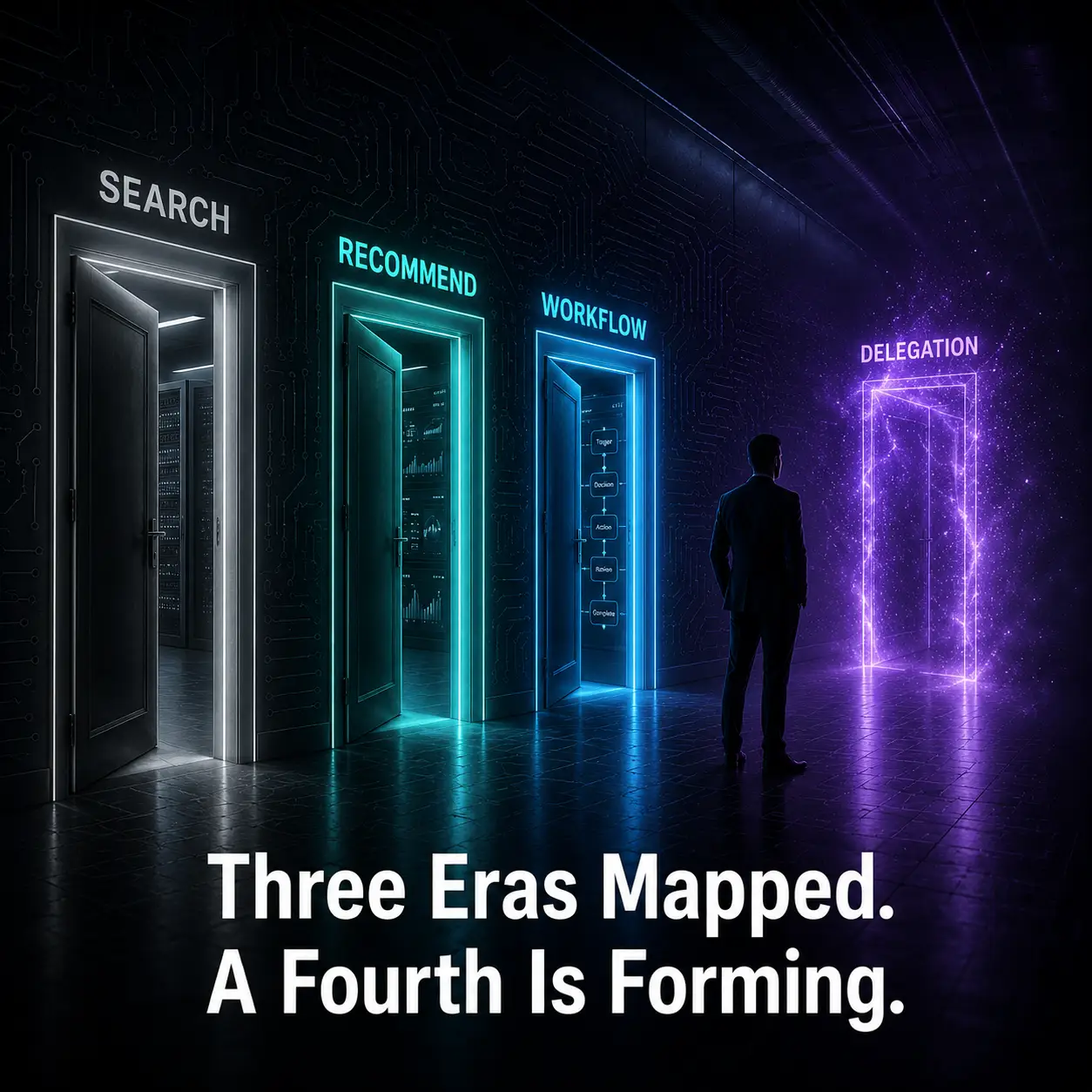
Three eras of AI visibility have defined the competitive landscape over the past several years.
The search era rewarded discoverability. Businesses that optimized for keywords, rankings, and search engine results earned the right to be found by buyers actively looking for solutions.
The recommendation era shifted the game. AI systems like ChatGPT, Claude, Gemini, and Perplexity began recommending businesses directly to buyers. Visibility moved from search results into AI generated answers. The question became whether AI would include your brand on the shortlist when a buyer asked for options.
The workflow era raised the bar further. AI stopped simply recommending names and started building decision frameworks for buyers. When someone asks ChatGPT to evaluate vendors or asks Perplexity to structure a procurement comparison, AI constructs the evaluation architecture. Brands included in that workflow get evaluated. Brands excluded from it may never enter the decision process at all.
Those three eras are real. They are measurable. And most businesses are still catching up to the second one.
But a fourth era is beginning to form.
What Delegation Means for AI Visibility
AI systems are starting to move beyond including your brand in decision workflows. They are beginning to take action on behalf of buyers.
This is not theoretical. It is happening in observable ways across ChatGPT, Claude, Gemini, and Perplexity as these platforms gain execution capabilities.
When a buyer asks an AI assistant to compare vendors and schedule a call with the best fit, the AI is not just recommending. It is coordinating an action. When a buyer asks AI to build a vendor scorecard and initiate procurement for the top two options, AI is acting as a decision coordinator.
The delegation era introduces a fundamentally different requirement. It is no longer enough for AI to know your brand, recommend your brand, or include your brand in a workflow. AI must be able to act on behalf of your brand.
Why Delegation Is Different From Workflow Inclusion
Workflow inclusion means AI includes your brand when it builds evaluation frameworks for buyers. That is a presence challenge. Your brand needs to be visible, credible, and consistently associated with the right category so AI includes you in the comparison.
Delegation goes further. Delegation means AI can interact with your business programmatically, securely, and transparently to take actions that move the buyer journey forward.
The difference matters because a brand can be perfectly visible in AI workflows but completely unable to be acted on. AI might recommend your business in a vendor scorecard but have no way to book a meeting with you, retrieve your pricing, or initiate a procurement step on your behalf.
That gap between recommendation presence and delegation readiness is where the next competitive advantage lives.
The Five Dimensions of Delegation Readiness
Five things need to be true before AI systems like ChatGPT, Claude, Gemini, or Perplexity can confidently act on behalf of your business.
First, action capability exposure. Can AI understand what actions your business enables? If an AI assistant cannot determine that you offer demos, consultations, pricing, or onboarding, it cannot include you in execution workflows.
Second, API accessibility. Can AI connect to your services? Delegation requires programmatic integration. Without it, AI cannot act on your behalf regardless of how well it recommends you.
Third, authorization controls. Can actions be performed securely and with proper governance? Buyers and AI systems both need confidence that actions taken on your behalf are governed.
Fourth, execution transparency. Can AI explain why it took a particular action? When AI books a meeting or initiates procurement, both the buyer and your business need to understand the reasoning.
Fifth, auditability. Can every decision AI makes on your behalf be reviewed? Actions without audit trails break the trust required for delegation.
Why This Matters Right Now
Three signals are converging that make delegation readiness increasingly relevant.
AI assistants are gaining execution capabilities. ChatGPT, Claude, Gemini, and Perplexity are increasingly able to browse, book, retrieve, and coordinate actions across systems. These are not future features. They are shipping now.
Buyers are delegating earlier in their journey. Instead of researching vendors and then acting separately, buyers are asking AI to handle both steps in a single prompt. “Find three vendors and schedule a call with the best fit” is becoming one request rather than a multi step process.
The trust threshold is rising. AI systems are developing preferences for businesses they can interact with programmatically, verify independently, and explain confidently. Brands that meet this threshold get included in execution workflows. Brands that do not get recommended but never activated.
What CMOs Should Be Measuring
Most marketing dashboards today measure what happens after a buyer reaches the website. Some teams have begun measuring whether AI recommends their brand. Very few are asking whether AI can act on behalf of their business.
The delegation audit is straightforward. Can an AI assistant book a meeting with your business without human intervention? Can it retrieve pricing or service information programmatically? Can it explain your authorization and security processes? Can it execute actions safely and transparently? Can it verify outcomes?
Most businesses will find they score well on visibility and recommendation presence but have significant gaps on delegation readiness.
The Connection to AI Memory and Narrative Defense
Delegation readiness does not exist in isolation. It builds on top of the intelligence layers that precede it.
AI must first remember your brand accurately and consistently. That is what Memory Intelligence measures. If AI carries inaccurate beliefs about your business or has locked you into the wrong category, delegation readiness is impossible.
AI must also describe your brand correctly. That is what Narrative Defense protects against. If AI misrepresents what your business does or carries outdated claims, no amount of API accessibility will overcome the trust deficit.
You cannot delegate to a system that misunderstands who you are. Delegation readiness starts with accurate AI memory and honest narrative. Everything else builds on top of that foundation.
The Direction of Travel
Search rewarded discoverability. Recommendations rewarded influence. Workflows rewarded inclusion. Delegation will reward trust.
The brands that build delegation readiness now are establishing a compounding advantage. Because once AI can confidently act on behalf of your business, that capability becomes part of how AI helps buyers decide and execute. Late movers will find that position very difficult to displace.
Three eras have been mapped. A fourth is forming. The question is whether your strategy is built for where the market is heading.
Frequently Asked Questions
What is delegation readiness in AI visibility? Delegation readiness is whether AI systems like ChatGPT, Claude, Gemini, and Perplexity can confidently act on behalf of your business. This goes beyond recommendation or inclusion. It means AI can book meetings, retrieve pricing, initiate procurement, and execute actions for buyers without human intervention.
How is delegation different from AI recommendation? AI recommendation means your brand appears when buyers ask for suggestions. Delegation means AI can take action on your behalf. A brand can be recommended consistently but still lack the infrastructure for AI to act on it. Delegation requires API access, authorization controls, execution transparency, and auditability.
What are the four eras of AI visibility? The four eras are search (can buyers find you), recommendation (will AI choose you), workflow (will AI include you in decision frameworks), and delegation (will AI act on your behalf). Each era raised the competitive bar and rewarded a different capability.
How do I measure whether my business is delegation ready? Run a five question audit. Can AI book a meeting with you without human help? Can it retrieve your pricing programmatically? Can it explain your authorization process? Can it execute actions safely? Can it verify outcomes? Score each as no capability, partial capability, or AI ready capability.
Why does AI memory matter for delegation readiness? AI must remember your brand accurately before it can act on your behalf. If AI systems like ChatGPT or Perplexity carry inaccurate beliefs about your business, misclassify your category, or hold outdated claims, delegation readiness is impossible regardless of your technical infrastructure.
Which AI platforms are gaining delegation capabilities? ChatGPT, Claude, Gemini, and Perplexity are all expanding their ability to browse, book, retrieve information, and coordinate actions across external systems. These execution capabilities are shipping in current versions and updates, making delegation readiness increasingly relevant now.
Start here: axissuite.ai