Consider a hypothetical prospective buyer who asks ChatGPT, Claude, Gemini, or Perplexity about a company. The answer describes what the company offers, who its customers are and what it can do. It is specific and fluent, and anyone at that company who read it would probably feel relieved. Before treating the answer as progress, though, it is worth checking what it rests on.
A fluent answer is easy to accept. Tone carries a lot of weight when we read, and a confident paragraph with a link or two looks well founded. But tone is not evidence, and a description of a company is not one claim. It is several.
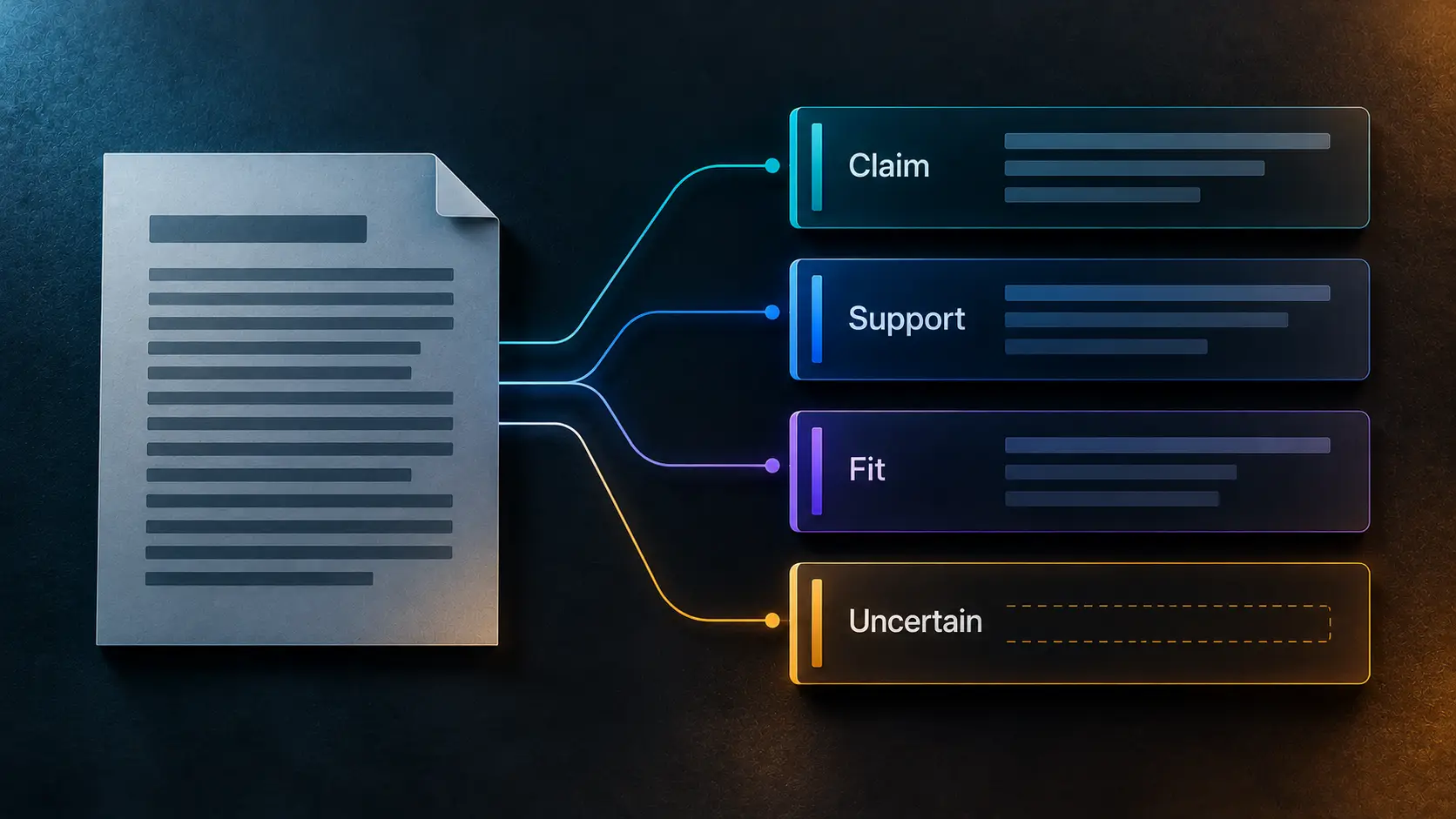
Start by breaking it up. One sentence says what the company offers. Another says who it serves. Another says what it can do, where it operates, or how long it has existed. Each one can be right, wrong, out of date, or about a different company with a similar name. Writing each claim on its own line is the first step, because it changes what you are looking at. You stop judging a paragraph and start examining individual statements.
The second question is what the cited or inspected source actually supports. If the answer includes a link, open it and read the part that bears on the claim. A link is a pointer. It shows where to look, and it does not show whether the page says what the sentence says. If the answer names no source, you can look for one yourself, but then you only know that something exists which could support the claim. You do not know it is what the engine used, and what happens inside a model is not visible from outside the provider.
As you read, note whose page it is. A company’s own website supports a claim by making the same claim. That is worth knowing, because it shows whether the AI repeated the company’s description accurately. It is also the company agreeing with itself. Independent corroboration comes from someone else: a customer review, a directory listing, an analyst note, a news article, a partner’s page. Both matter, for different reasons. An answer that rests only on the company’s own pages can be accurate and thinly corroborated. An answer that rests only on independent sources can be well corroborated and still describe an earlier version of the business.
The third question is whether the source concerns the right company, offering and time period. This catches more problems than people expect. Similar names, a retired product line, an acquisition or an old announcement can each make a source look relevant when it is not about the thing the buyer asked about. Check the name, the product and the date on the page itself.
The fourth question is what remains uncertain. List what you could not verify, and record the engine, the exact question and the date, since answers can differ between engines and between runs. If you checked a claim and found nothing, write “no support found.” That is different from “false,” and the difference is easy to lose.
What can the check support? A narrow statement: for this claim, in this answer, on this engine, on this date, here is what a source says and where it falls short. It does not show that the whole answer is correct, and it does not show why the engine said what it said. Search-assisted correctness is not proof that an engine knows the company without searching. A visible link is not a complete record of where an answer came from. A source that supports a claim has not been shown to be the reason the answer contains it.
A claim with no visible support is also not necessarily false. It may be accurate, and simply unsupported by anything you can find. Unsupported is a finding about the evidence, not a verdict about the truth.
In our framework, a citation is its own level, separate from a recommendation, and Mentioned, Cited, Recommended and Chosen are distinctions that keep different observations from being merged. A source appearing in an answer is one observation. What that source supports is another.
It is also worth running the check on more than one engine. ChatGPT, Claude, Gemini, and Perplexity can describe the same company differently, and a result on one engine does not describe the others. Keeping each engine’s record separate stops a clean result on one from covering for a gap on another.
This is useful before a marketing team tells anyone an AI answer is good news, before it commissions corrective work, and before it accepts a vendor’s progress claim. A short record takes a few minutes per answer: the claims, what supports each, which support is the company’s own and which is independent, what does not fit, and what is still uncertain. It also gives the team something specific to say, such as “two claims have support on our own pages, one has independent corroboration, and one has no support found,” in place of “the answer looked fine.”
A convincing description is where the checking starts. It is not where it ends.
FAQ
How do I check what an AI answer about my company rests on?
Break the answer into single claims, then read what the cited or inspected source says about each one. Ask whether the source concerns the right company, offering and time period, and write down what remains uncertain. This works the same way for answers from ChatGPT, Claude, Gemini, and Perplexity.
Does a link in an AI answer prove the claim next to it?
No. A link shows where to look, and the page still has to say what the sentence says. Even when it does, a visible link is not a complete record of where the answer came from.
What is the difference between a company’s own page and independent corroboration?
A company’s own page makes the same claim the company makes about itself, which shows whether the AI repeated it accurately. Independent corroboration comes from someone else, such as a review, directory, analyst note or article. Both are useful, and they answer different questions.
If I find no support for a claim, does that mean it is wrong?
Not necessarily. The claim may be accurate and simply not supported by anything you can find. Record it as “no support found” and keep it separate from “false.”
If an AI answer about my company is correct, does that mean the engine knows my company?
Not on its own. An engine that searches can produce a correct answer without holding that knowledge itself, so search-assisted correctness is not proof of unaided knowledge.
Is this article reporting a result from Axis Suite?
No. It describes a method for checking an AI answer and reports no result for any specific brand.
About Axis Suite
Axis Suite is the independent intelligence layer that tracks what AI says about your brand and the observable evidence behind it, retrieval, narrative, recommendation, and corroboration signals, across engines including ChatGPT, Claude, Gemini, and Perplexity. Built by TrendAxis, Axis Suite works from a framework that separates Mentioned, Cited, Recommended, and Chosen. Axis Suite is measurement infrastructure, not a marketing quick fix. Explore the Proof Center.