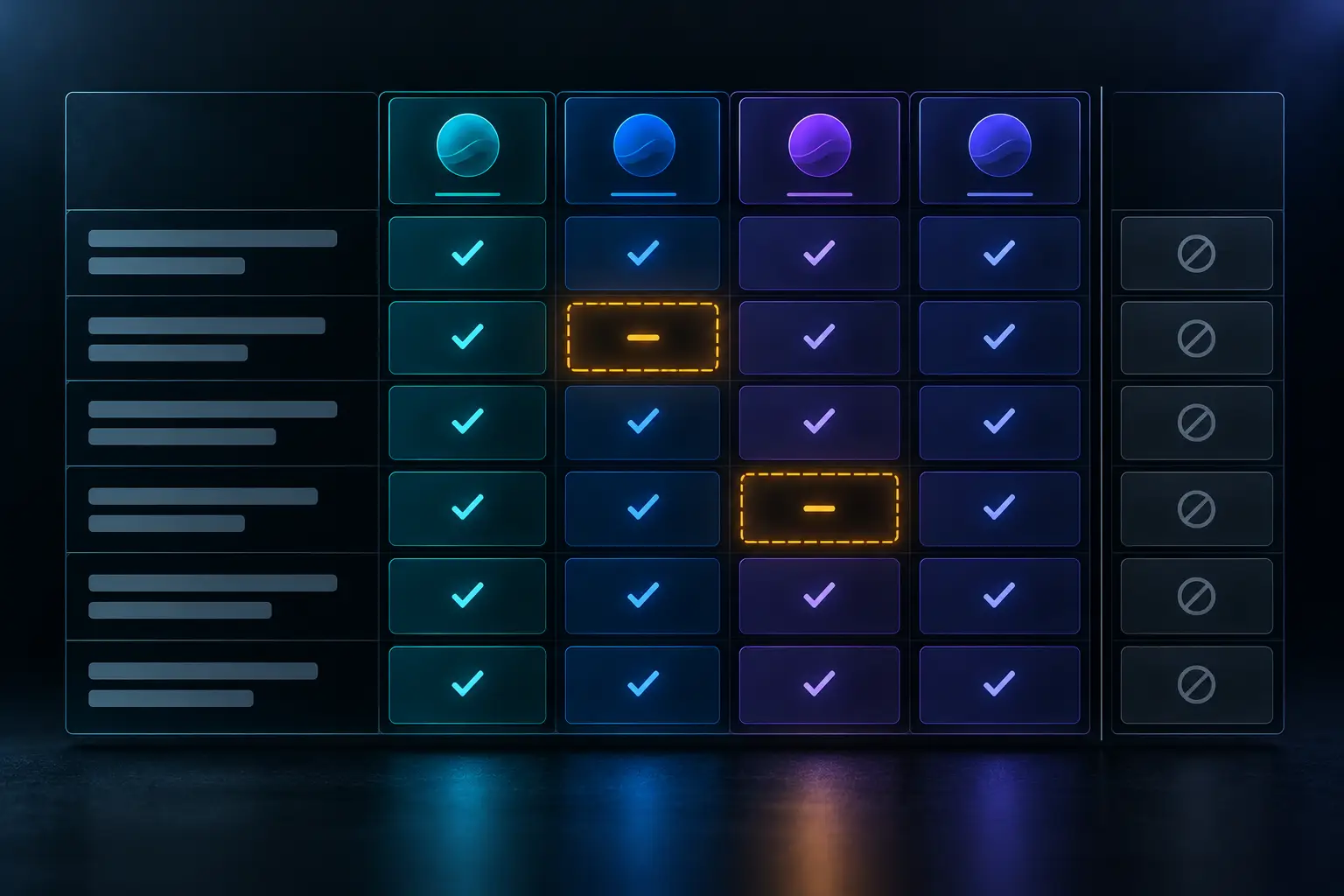
Everything in an AI visibility check depends on the questions. If the questions are the ones a buyer would really ask, the check shows something close to what a buyer might see. If they contain your own vocabulary, or only ask about your company by name, it shows something else. For a hypothetical buyer asking ChatGPT, Claude, Gemini, or Perplexity for options, the quality of the question panel decides whether the result is worth reading.
Begin with the situations your buyers are actually in. Think about who is asking, what they are trying to get done, what size of company they work for, and what constraint matters to them most. A procurement lead with a budget ceiling asks differently from an operations manager who needs something that works with existing tools. Each situation can become one or more questions. The aim is to cover the main situations, not to cover every possible phrasing.
Write each question in the buyer’s words. A buyer rarely uses a vendor’s product names, feature labels, or internal framing. She describes a problem. After drafting a question, read it for vocabulary that only your company would use, and replace it with language a newcomer to the category would use. If your own terms leaked in, the check has partly turned back into a named check.
Keep your company name out of the questions. The point of the panel is to see whether the brand appears in a list that was assembled without it. The named check still has a place, but it belongs in a different step: once the brand is missing from a list, asking each engine about the company by name helps show what the engine knows about it.
Decide on the panel before running anything, and then keep it fixed. Variations in wording that you want to test, such as two phrasings of the same need, should be part of the planned panel from the start, as separate items. A panel that changes between runs can’t be compared with its earlier results. Repeating the same panel later is how stability is assessed. Adding questions or changing the wording afterward is a separate diagnostic test, and its result isn’t directly comparable with the first one.
Record the conditions along with the results. For each run, note the date, the engines, and the exact text of each question. Keep the full text of the answers, because the wording of a caveat or a recommendation often matters more than the fact of a mention. For each question, record whether the response succeeded. Failed or missing responses must stay on their own line, separate from valid answers that did not mention the brand. A few missing responses don’t automatically undermine a result, so the working check is whether enough of the planned responses succeeded to support what is being reported.
Then record how the brand appeared in each valid answer: listed with no comment, listed with a caveat, recommended with a reason, or absent. Keep the engines separate, since ChatGPT, Claude, Gemini, and Perplexity can each answer differently, and a combined figure can hide a brand that appears on one and not on another.
A simple way to organize the panel is by situation. One group of questions could describe a buyer with a tight budget, another a buyer whose main concern is fitting an existing set of tools, another a buyer replacing something that no longer works. Within each group, the same need can be phrased two ways as separate planned items. Labeling the groups makes the results easier to read, because a pattern across a situation says more than a scattered list of answers.
Plan for the person who will read the record later. Someone who wasn’t there should be able to tell what was asked, which engines answered, which responses succeeded, and how the brand was presented, without having to ask. A record that supports that is also one the team can repeat, which is the point of fixing the panel. If an early result looks surprising, resist the urge to add questions mid-stream. Add them in a second, separately labeled panel, so the first panel stays comparable with its own repeats.
Be modest about what the panel can show. It supports a statement about these questions, on these engines, at this time. It doesn’t show why a brand appeared or didn’t, and it doesn’t show what a buyer did afterward. It also doesn’t show that a change made between two runs caused any difference between them. A before-and-after comparison on its own can’t separate the change from everything else that moved.
A good panel is small enough to repeat consistently and broad enough to reflect the situations that matter. There is no universal size. What makes it useful is that it is written in the buyer’s words, defined in advance, and kept fixed when it is repeated.
FAQ
How many questions should a buyer question panel include?
There is no universal number. It should be large enough to cover the main situations your buyers describe and small enough to repeat consistently. What matters most is that the panel is defined in advance and kept fixed when repeated.
Should my company name appear in the questions?
No. The panel tests whether the brand appears in a list built without it. Asking each engine about the company by name is a separate step, useful once the brand turns out to be missing.
How do I keep my own vocabulary out of the questions?
Write each question from the buyer’s side first. Then read it for product names, feature labels, or internal terms that only your company would use, and replace them with the words a newcomer to the category would use.
What counts as a repeat of the same panel?
Running the same questions again on the same engines. Reworded or additional questions are a separate diagnostic test, and their results aren’t directly comparable with the original panel.
How should I record failed or missing responses from ChatGPT, Claude, Gemini, or Perplexity?
On their own line, separate from valid answers that did not mention your brand. A few missing responses don’t automatically undermine a result, so check whether enough of the planned responses succeeded to support what you are reporting.
Does a change in results after I edit my site prove the edit worked?
No. A before-and-after change on its own doesn’t show what caused it. State in advance what observation would indicate an effect, repeat the same panel, and treat the result as one piece of evidence.
About Axis Suite
Axis Suite is the independent intelligence layer that tracks what AI says about your brand and the observable evidence behind it, retrieval, narrative, recommendation, and corroboration signals, across engines including ChatGPT, Claude, Gemini, and Perplexity. Built by TrendAxis, Axis Suite works from a framework that separates Mentioned, Cited, Recommended, and Chosen. Axis Suite is measurement infrastructure, not a marketing quick fix. Explore the Proof Center.