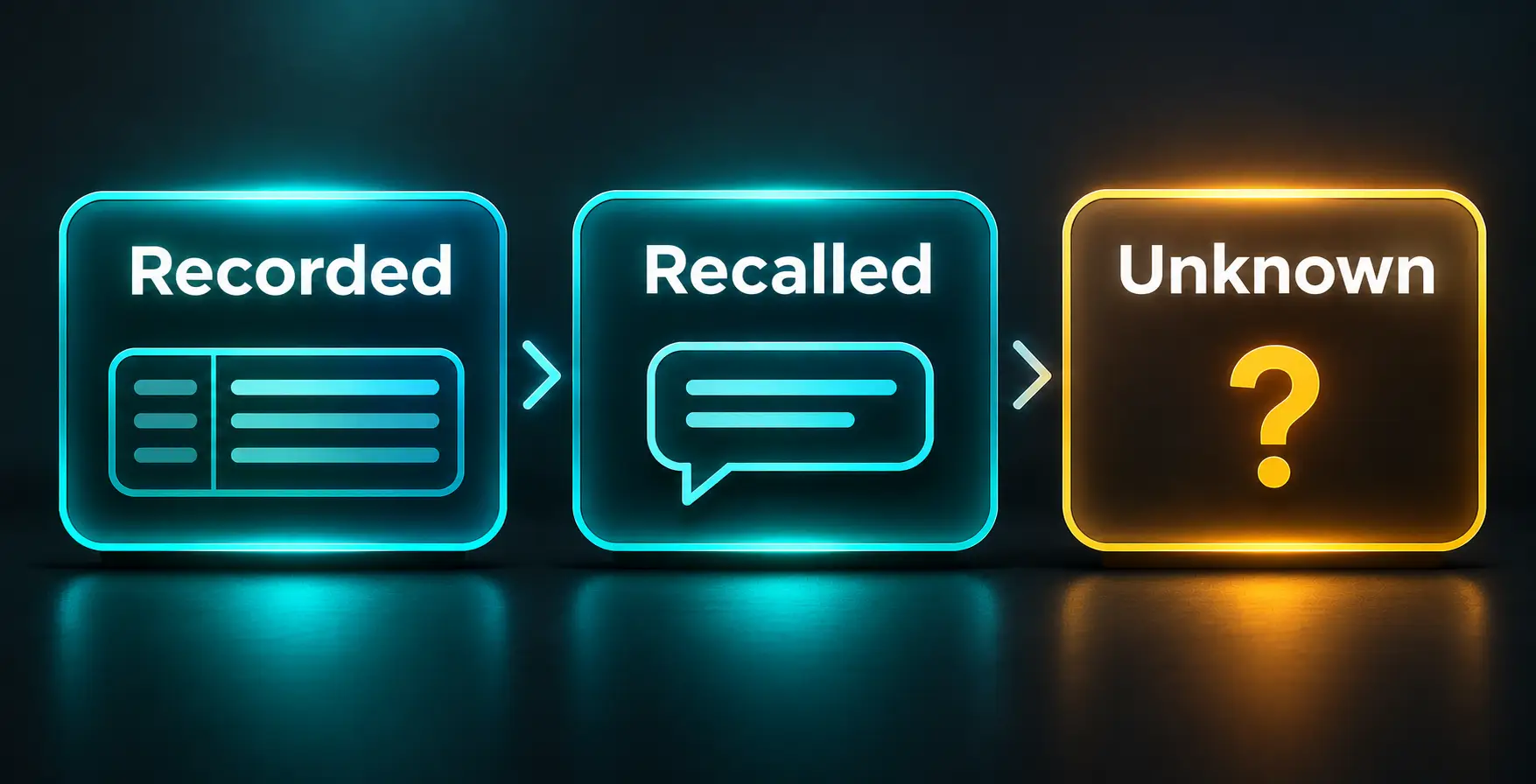
Consider a fictional sensor maker, Alder Sensors, that has just closed a deal. In the win interview, the buyer recalls using an AI assistant to build the shortlist of vendors. The CRM logged the opportunity as created from a reply to an outbound sales email, because that was the first touch it captured. Nothing in this scenario is real, and it is not a finding. It sets up a question that marketing leaders get asked: at the next budget meeting, what should the team report?
The two records do not conflict. The CRM recorded the first touch it captured. The buyer described what helped shape the shortlist. They answer different questions, and both can be true. The trouble starts when a meeting treats them as rivals. One person points to the CRM and credits outbound. Another points to the buyer and credits AI. Each is using one record to settle a question it cannot settle alone.
It helps to be clear about why the two records differ. A CRM can only log what its systems observe, such as a form submission, a reply to an email or a tagged link. A conversation between a buyer and an assistant leaves no trace in those systems unless the buyer mentions it. So the absence of an AI entry in the CRM is not evidence that no assistant was involved, and the presence of an outbound entry does not show that outbound created the interest. It shows that outbound was the first touch the system could see.
Start with what the buyer’s account is worth. It is evidence that, by this buyer’s recollection, an assistant such as ChatGPT, Claude, Gemini or Perplexity played a part in how the shortlist formed. That deserves to be taken seriously and written down. Like any recollection, it reflects what the buyer remembers and how the question was asked. It does not show whether the deal would have closed without the assistant, how often deals follow a similar path, or what the assistant actually showed the buyer.
Now look at the decision inside the budget question. Two different decisions hide in “what do we do with this?” The first is to investigate: add a question to future win interviews, record the answers, and look again on a set date. That costs a few minutes in a conversation. The second is to reallocate: move real money from one channel toward another. That is harder to undo, so it asks for more. A single account can justify the first without justifying the second.
There are three things a team could do with the evidence, and naming them keeps the meeting orderly. It could do nothing, which leaves the buyer’s account unrecorded and the question unanswered. It could investigate, which asks every future buyer the same question and sets a review date. Or it could reallocate, which acts on the account as though it were a pattern. The first loses the evidence, the third outruns it, and the second keeps it usable. Someone also has to own the question. Win interviews are often run by sales or customer success, so agree in advance who asks it, in what words, and where the answer is stored.
IAB, the advertising industry’s trade body, gave this distinction a vocabulary on November 12 with its AI-Era Attribution Blueprint. Its announcement describes a framework for classifying AI’s role in a conversion and evaluating which parties can claim credit, and it separates the right to be evaluated for credit from credit itself. This article relies only on the announcement and not on the full Blueprint, which it did not review. The announcement also says that much of the evidence needed to support such claims is either not captured or sits inside AI platforms. That is a statement about the industry, and a small team’s records have the same gaps.
A short record keeps the evidence usable. Three fields are enough. Record where the conversion was logged. Record what the buyer says helped them decide, in the buyer’s own words. Record what remains unknown. For Alder, a filled version might read: logged as an outbound reply; the buyer used an AI assistant to build the shortlist, in the buyer’s words; unknown is whether the sale would have happened without it, how many other deals look like this, and what the buyer was shown.
With that record, the team has something honest to say at the budget meeting. For example: “One buyer reports that AI helped shape the shortlist. Our CRM logged the deal as outbound. We are asking every buyer the same question and will review on an agreed date, and we are not proposing to move budget on this alone.” That sentence neither dismisses the buyer nor overreaches.
Dismissing the account has a cost too. Evidence of influence that does not fit a CRM field is easy to lose, and a team that never writes it down cannot notice a pattern later. Recording it is cheap. Acting on it is a separate step, and it can wait for more.
FAQ
Can one buyer’s account justify moving budget? Not on its own. It is useful evidence that AI played a part, but it does not show whether the sale would have happened without it or how often deals look like this. It can justify asking better questions and recording the answers.
Why can the CRM and the buyer give different answers? They record different things. The CRM logs the first touch it captured, while the buyer describes what helped shape the decision. Both can be accurate.
What is the difference between a claim and credit in IAB’s framework? IAB’s announcement separates the right to be evaluated for credit from credit itself. A buyer’s account can support a claim to be evaluated, and credit needs more evidence.
Is this article based on the full IAB Blueprint? No. It relies on IAB’s public announcement of November 12 and did not review the full Blueprint.
What should a team record after a win interview? Where the conversion was logged, what the buyer says helped them decide in the buyer’s own words, and what remains unknown. Keeping the three fields separate stops one record from standing in for another.
Is this article reporting a result from Axis Suite? No. The sensor maker and the buyer are fictional, and the article describes a way to read evidence without reporting a result for any brand.
About Axis Suite Axis Suite is the independent intelligence layer that tracks what AI says about your brand and the observable evidence behind it, retrieval, narrative, recommendation, and corroboration signals, across engines including ChatGPT, Claude, Gemini, and Perplexity. Built by TrendAxis, Axis Suite works from a framework that separates Mentioned, Cited, Recommended, and Chosen. Axis Suite is measurement infrastructure, not a marketing quick fix. Explore the Proof Center.