Suppose a brand appears when a hypothetical buyer asks ChatGPT, Claude, Gemini, or Perplexity for options. That is the beginning of an answer, not the end of one. The more useful question is what the buyer actually saw, because a name appearing in a list can mean several different things.
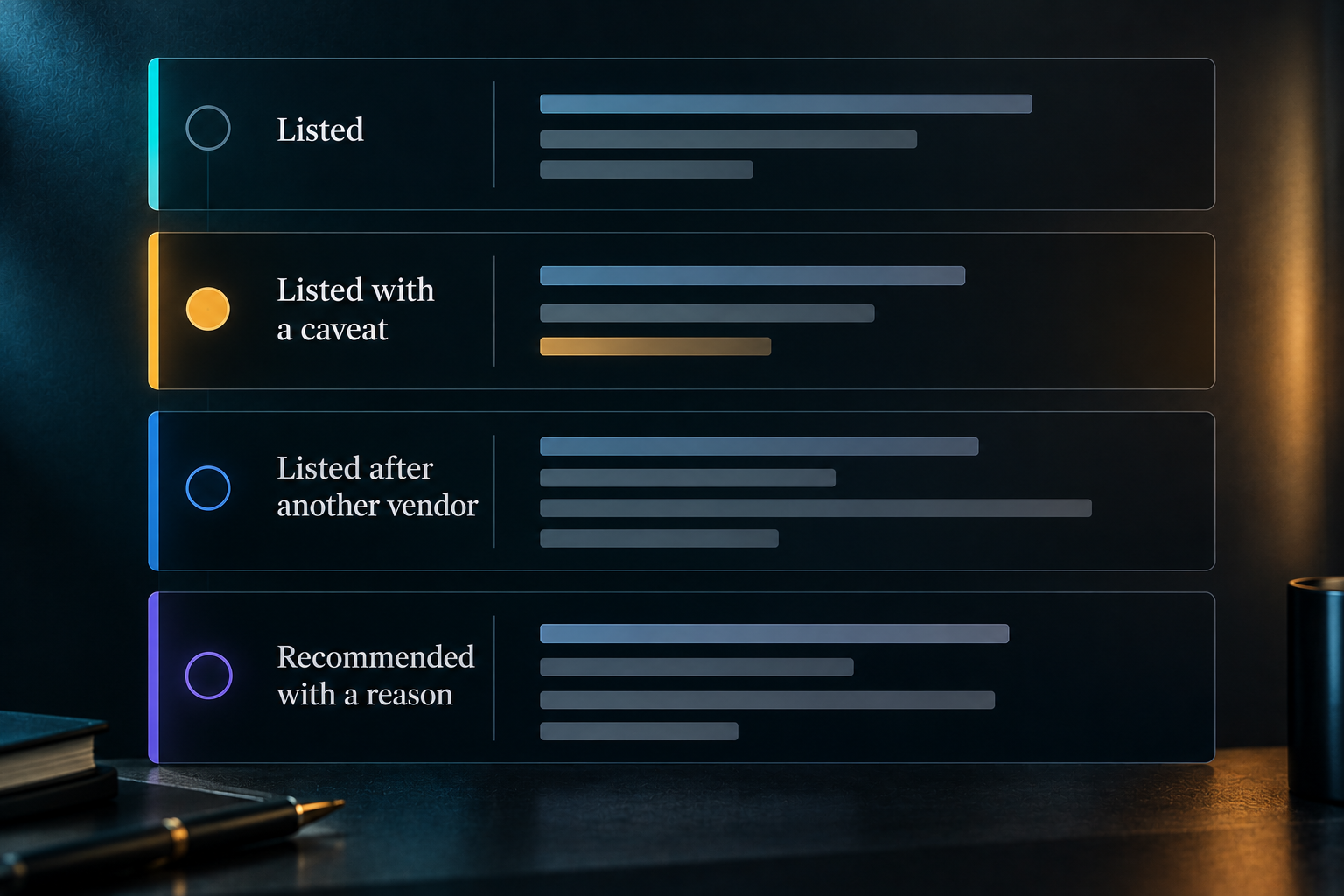
Consider the ways an answer might treat a brand. It might list the brand with no comment at all, as one name among several. It might list the brand with a caveat, such as a note about price, size, or fit. It might name another vendor first and describe that vendor as the better match. Or it might recommend the brand and give a reason that connects to what the buyer said she needed. These are illustrations, not findings, but each is a plausible way for a name to appear, and each leaves the buyer with a different impression.
A simple count of mentions treats all of these as one thing. That is convenient for reporting and misleading for interpretation. If a brand appears in the answers to many questions and is listed with a caveat in most of them, the count reports the appearances and the buyer’s experience says something else. Any number that collapses those differences should be read as a count of appearances, not a measure of how the brand was received.
In our framework, Mentioned, Cited, Recommended, and Chosen are separate levels. Mentioned means the brand came up. Cited means a source was referenced in the answer. Recommended means the AI system suggested the brand. Chosen means a person actually went with it. Appearing among options sits near the first level. It is an observation about the answer, and it says nothing yet about the later levels.
Two of those levels belong to different parties. Recommendation is an outcome the AI produces, and it can be observed in the text of an answer. Choice is an outcome the buyer produces, and it happens somewhere an AI visibility check can’t see. Treating a recommendation as a choice skips the buyer entirely. A brand can be recommended without being chosen, and chosen without ever being recommended, and observing the answer alone can’t separate those cases.
The same care applies to the second level. A citation, meaning a source referenced in an answer, is not a recommendation either. An answer can cite a brand’s page while recommending a different vendor, and it can recommend a brand without citing anything. Each level is its own claim, and moving up on one doesn’t confirm the next.
The reason an answer gives is worth reading closely. When ChatGPT, Claude, Gemini, or Perplexity recommends a brand and says why, that stated reason is part of what the buyer reads. It is not an observation of why the system produced the recommendation, since that internal reasoning isn’t visible from outside. It is the text on the page, and it can be compared with what the buyer asked for. A recommendation whose stated reason matches the buyer’s need reads differently from one whose reason is generic.
Presentation can also differ between engines for the same question. One engine may list a brand without comment where another attaches a caveat. Keeping the engines separate in the record shows those differences, and a blended figure hides them. If the same brand is recommended on one engine and merely listed on another, that is two observations, not one averaged result.
In practice, this changes how an answer should be reviewed. Along with whether the brand appeared, it helps to record what the answer said about it. A simple scheme is enough: listed with no comment, listed with a caveat, recommended with a reason, or absent. Keeping the text of the answers matters as well, because the wording of a caveat often tells you more than the fact of the mention. Failed or missing responses should stay on their own line, separate from valid answers that did not mention the brand, so a collection problem is never read as a result. There is no need to assign weights or build a score before you know what you are counting.
What follows from a result like this? A narrow set of statements: on these engines, for these questions, at this time, the brand was presented in this way. It does not establish why. It does not show what any buyer did afterward. And it does not show that a different presentation would have changed a decision. Those are questions for further observation, not conclusions to draw from one set of answers.
Treating every mention as a recommendation overstates what a buyer saw. Treating every absence as a failure overstates what the evidence shows. The work is in keeping the claim no larger than the observation, and keeping each level separate until there is a reason to connect them. For a team reviewing its own results, that means reading the full text of the answers before reading the summary, and being willing to say that a brand was named, and nothing more, when that is all the answer shows.
FAQ
What is the difference between being mentioned and being recommended by an AI assistant?
Mentioned means the brand came up in an answer. Recommended means the assistant suggested the brand, usually with some reason tied to the buyer’s request. A brand can be mentioned without being recommended.
Can a brand be recommended without being chosen?
Yes. Recommendation is an outcome the AI produces, and choice is an outcome the buyer produces afterward. An AI visibility check can observe the first and generally can’t observe the second.
Is a citation the same as a recommendation?
No. A citation means a source was referenced in the answer. An answer can cite a brand’s page and still recommend a different vendor.
Why isn’t a count of mentions enough?
A count treats a plain listing, a listing with a caveat, and a recommendation with a reason as the same event. They leave a buyer with different impressions, so a single count can hide the difference.
How should I record how my brand appeared in an answer from ChatGPT, Claude, Gemini, or Perplexity?
A simple scheme works: listed with no comment, listed with a caveat, recommended with a reason, or absent. Keep the text of the answer too, since the wording often carries more information than the mention itself.
Does appearing in an answer show that buyers will choose my brand?
No. It shows that the brand appeared in an answer under certain conditions. What a buyer did afterward is a separate outcome that the answer alone doesn’t show.
About Axis Suite
Axis Suite is the independent intelligence layer that tracks what AI says about your brand and the observable evidence behind it, retrieval, narrative, recommendation, and corroboration signals, across engines including ChatGPT, Claude, Gemini, and Perplexity. Built by TrendAxis, Axis Suite works from a framework that separates Mentioned, Cited, Recommended, and Chosen. Axis Suite is measurement infrastructure, not a marketing quick fix. Explore the Proof Center.