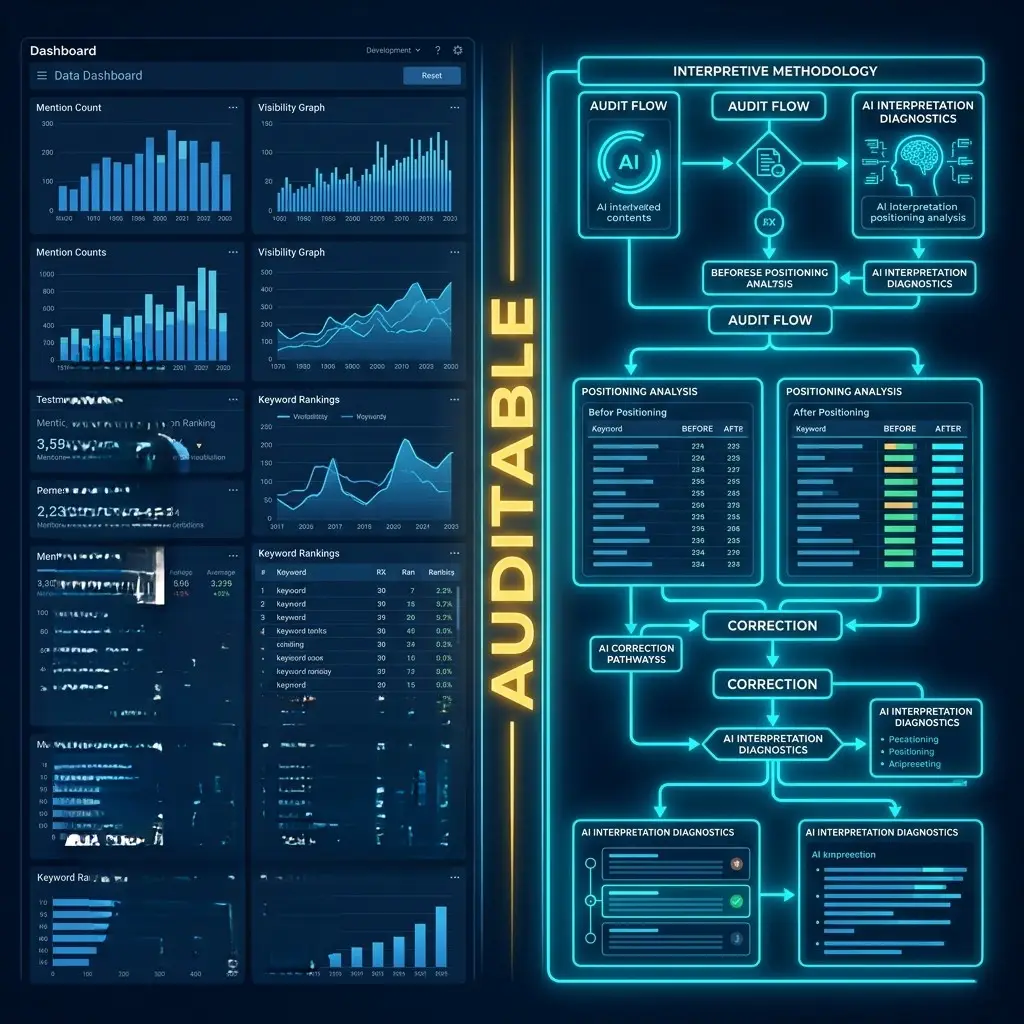
AI visibility sounds measurable at first.
You can count mentions. You can track whether your brand appears in AI answers. You can compare visibility over time and report that number upward. For many teams, that feels like progress.
Then a harder question shows up:
Can you prove this is repeatable?
That question changes the conversation. It shifts the focus from surface outcomes to the system behind them. It asks whether your team understands why AI describes your brand the way it does, why that description changes, and what actions reliably improve it over time.
This is where many AI visibility strategies break down. They measure exposure, but not interpretation. They show what happened, but not why it happened. And without that layer of understanding, it is hard to build a repeatable process for narrative defense.
This post explains why traditional dashboards fall short, why auditing interpretation matters more than simple visibility monitoring, and how Axis Suite helps brands move from reactive tracking to a repeatable methodology.
Why the repeatability question matters
A single good result is not a strategy.
If your brand appears in one AI-generated answer, that does not mean your positioning is stable. If mentions rise this month, that does not mean AI understands your value clearly. If one prompt produces a strong description, that does not mean the next ten prompts will do the same.
Repeatability matters because AI-driven discovery is not just about presence. It is about pattern.
Brands need to know:
- Why one competitor is described more confidently
- Why summaries shift across prompts or sessions
- Why certain differentiators show up while others disappear
- Why some brands become the default recommendation again and again
These are strategic questions. They affect category position, buyer trust, shortlist inclusion, and conversion quality. Yet most reporting frameworks for AI visibility still focus on output counts rather than interpretive logic.
That is the gap.
The limits of traditional AI visibility dashboards
Most dashboards are built to answer basic performance questions. They can be useful for monitoring movement at a high level. They can show whether your brand is appearing more often, whether share of voice is changing, or whether a campaign increased visibility.
But they are limited.
What traditional dashboards usually track
A typical AI visibility dashboard focuses on metrics such as:
- Number of brand mentions
- Frequency of appearance in AI answers
- Ranking or placement in lists
- Prompt coverage across topics
- Share of visibility versus competitors
These data points can help teams see whether they are present in the conversation. They can highlight trends and provide a baseline. But they do not explain the narrative quality of that presence.
What traditional dashboards miss
A brand can appear often and still be misunderstood.
That is the central weakness of surface-level measurement. Visibility metrics rarely explain:
- Why AI places your brand in the wrong category
- Why a key product differentiator is missing from summaries
- Why your competitors are framed more clearly
- Why your brand sounds generic in comparison prompts
- Why recommendation confidence varies from one output to another
In other words, dashboards show that something happened. They rarely show why it happened.
That makes them weak tools for strategic correction. If you do not know what is driving the output, you do not know what to fix.
Surface visibility is not the same as narrative strength
This is the mistake many teams make early.
They assume visibility equals understanding. If AI can find the brand, then the brand must be positioned well. If descriptions are mostly accurate, then messaging must be working. If mentions increase, then strategy must be improving.
But AI does not simply “find” brands. It interprets them.
It compresses websites, product pages, comparison content, reviews, thought leadership, and other signals into a short narrative. That narrative may be broadly accurate while still being strategically weak.
For example, AI may:
- Recognize your company name but use the wrong category label
- Summarize your product without mentioning its strongest capability
- Compare you to the wrong set of competitors
- Describe your offer in generic language that weakens distinction
None of those problems may appear in a visibility graph. Yet all of them shape buyer perception.
This is why the real issue is often not:
AI can’t find us.
It is:
AI understands us differently than we think it does.
That distinction is the foundation of a better methodology.
Auditing interpretation: the shift that changes strategy
If monitoring visibility tells you where you appear, auditing interpretation tells you how AI is constructing meaning around your brand.
That is a much more valuable layer of analysis.
What auditing interpretation means
Auditing interpretation is the process of examining how AI systems describe, compare, and recommend your brand across prompts, contexts, and competitor scenarios. It looks beyond mention counts to understand the narrative being formed.
This includes questions such as:
- What does AI believe our brand is?
- What category does it place us in?
- Which features does it treat as central?
- How does it compare us to alternatives?
- Where does its interpretation diverge from our intended positioning?
These questions help teams move from passive monitoring to active diagnosis.
Why this approach is more strategic
A good methodology does not just report outcomes. It identifies causes.
When you audit interpretation, you can see whether your messaging is being translated correctly into AI outputs. You can detect narrative drift before it becomes a bigger market problem. You can isolate the signals that need reinforcement and build a more repeatable path to improvement.
That is what makes auditing interpretation more useful than a dashboard alone. It creates a framework for action.
Why repeatability requires methodology, not just metrics
Repeatability depends on process.
If your team wants to improve AI outcomes over time, it needs more than observations. It needs a structured way to test assumptions, identify gaps, and strengthen narrative signals.
A repeatable methodology usually includes four steps:
1. Measure baseline visibility
First, confirm where and how often your brand appears. This establishes basic performance and competitive context.
2. Audit narrative interpretation
Next, examine how AI actually describes the brand. Look for category errors, omitted differentiators, generic phrasing, or weak comparison logic.
3. Identify narrative divergence
Then compare AI’s interpretation to your intended positioning. Where do they match? Where do they drift? Which parts of your story are not surviving compression?
4. Correct the underlying signals
Finally, strengthen the messaging, structure, and narrative cues that shape interpretation. This may include product pages, homepage framing, comparison content, FAQs, schema, and thought leadership.
Without these steps, teams are left reacting to symptoms. With them, they can create a reliable improvement loop.
How Axis Suite helps brands audit interpretation
This is where Axis Suite plays a strategic role.
Axis Suite is built to help brands move beyond basic AI visibility tracking and into a more disciplined model of narrative defense. Instead of stopping at surface metrics, it helps teams understand how AI interprets the brand, where that interpretation drifts, and what signals need correction.
Axis Suite turns visibility into diagnosis
Rather than treating AI visibility as a simple mention problem, Axis Suite helps teams analyze:
- Brand category placement
- Feature and differentiator recall
- Competitive comparison framing
- Narrative consistency across prompts
- Shifts in confidence and recommendation patterns
This makes it easier to see whether the brand is being understood the way the company intends.
Axis Suite helps identify narrative divergence
One of the hardest problems in AI-driven discovery is hidden divergence.
Your internal team may believe the brand is positioned clearly. Your website may look polished. Your product messaging may feel consistent. But AI can still compress that story in ways that weaken your market position.
Axis Suite helps expose that gap.
It shows where AI interpretation diverges from intended positioning so teams can act before that divergence shapes buyer perception at scale.
Axis Suite supports a repeatable narrative defense process
A repeatable methodology requires more than one-off testing. It needs ongoing monitoring, structured analysis, and clear correction pathways.
Axis Suite supports that process by helping teams:
- Monitor interpretation over time
- Detect changes in AI narrative patterns
- Audit outputs across different contexts
- Prioritize high-impact signal corrections
- Build a stronger framework for narrative defense
That is the difference between watching the problem and managing it.
From “AI can’t find us” to “AI understands us differently”
This shift is simple, but it changes everything.
Many AI visibility efforts begin with a discoverability mindset. The assumption is that if the brand is not performing well, the problem must be absence. Maybe AI cannot find the right pages. Maybe the company needs more content. Maybe it just needs more mentions.
Sometimes that is true. Often it is not.
In many cases, the brand is already visible. It is already present in answers. It is already entering the consideration set. The real issue is that AI is interpreting the brand with less precision than the company expects.
That can show up as:
- Overly broad category placement
- Missing core capabilities
- Soft or generic differentiation
- Inconsistent competitor framing
- Lower confidence in recommendations
Once teams understand this, their strategy improves. They stop chasing visibility volume alone and start improving the quality of interpretation.
That is a more durable path.
What a stronger AI visibility strategy looks like
A stronger strategy does not ignore metrics. It puts them in context.
You still need to know whether your brand appears. You still need to track changes in coverage and competitive presence. But those signals should be the starting point, not the end goal.
A stronger strategy combines visibility measurement with interpretation analysis.
Key elements of a better approach
Clear category ownership
Make sure your category language is explicit, repeated, and consistent across key surfaces. If AI places your brand in the wrong category, every downstream comparison may weaken.
Strong differentiator signaling
Your most important features and claims should not just appear on the site. They should be framed clearly enough to survive AI summarization.
Comparative precision
Competitive pages, messaging frameworks, and executive content should make distinctions machine-legible, not just human-readable.
Ongoing interpretation audits
AI outputs change. Buyer prompts change. Competitor signals change. Regular audits help teams catch drift before it compounds.
A correction loop
Insights only matter if they lead to action. Strong teams use interpretation analysis to guide updates in messaging, structure, and content priorities.
Axis Suite is designed to support this full loop, which is why it is useful for teams that want a method, not just a metric.
Practical questions to ask your team
If you want to assess whether your current approach is strong enough, start here:
- Can we explain why AI describes our brand the way it does?
- Do we know where AI interpretation diverges from our intended positioning?
- Can we identify which signals are shaping that interpretation?
- Do we have a repeatable process for correcting narrative drift?
- Are we measuring more than visibility alone?
If the answer to most of these is no, your current reporting may be informative but not strategic.
That is the opportunity.
Conclusion
The question “Can you prove this is repeatable?” exposes a real weakness in current AI visibility strategies.
Too many teams are still tracking surface outcomes and calling that insight. They measure mentions, appearances, and movement, but they cannot explain why AI favors one narrative over another. They can see the output, but not the reasoning behind it.
That is why the future of this category is not just monitoring visibility. It is auditing interpretation.
Axis Suite helps brands make that shift. It provides a methodology for understanding how AI describes a brand, where that narrative diverges from intended positioning, and which signals need correction to improve outcomes over time.
The result is a more repeatable approach to narrative defense.
Because the real problem is often not that AI cannot find your brand.
It is that AI understands your brand differently than you think it does.
And if you can diagnose that clearly, you can start to fix it systematically.