AI visibility can create a false sense of confidence.
If your brand appears in AI answers, gets described with reasonable accuracy, and shows up in relevant comparisons, it is easy to assume your positioning is intact. On the surface, that looks like success. But visibility alone does not tell you whether AI understands your brand the way you intended.
That is why we ran a narrative defense audit on our own company.
At Axis Suite, we help brands monitor and defend how AI systems interpret, compare, and recommend them over time. So we applied the same discipline to our own positioning. We wanted to see whether the signals we publish across our site, content, and product messaging were creating the narrative we meant to create.
What we found was not a crisis. It was more useful than that.
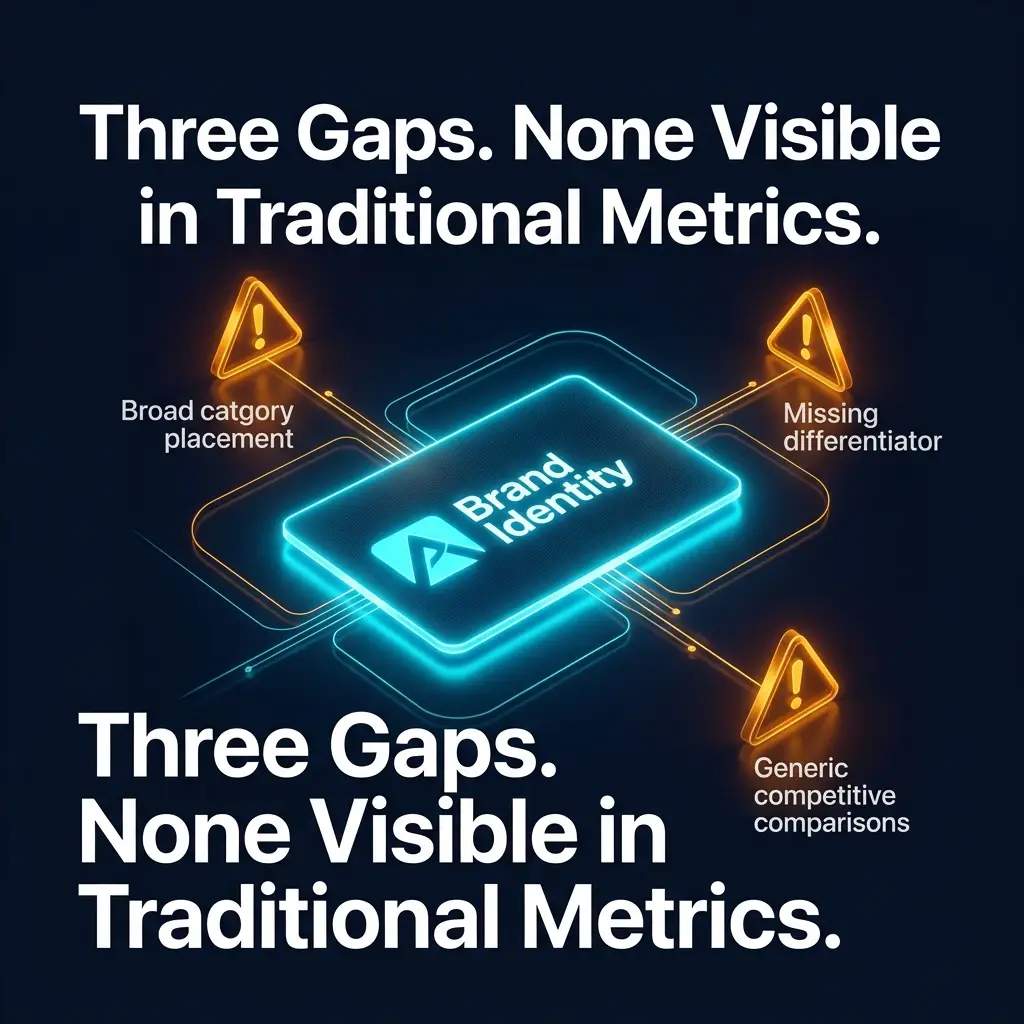
We found three specific gaps in how AI was interpreting Axis Suite. None of them were obvious in traditional metrics. None of them looked severe at first glance. But together, they showed how small narrative shifts can weaken differentiation, blur category definition, and reduce confidence in how a platform is evaluated.
This post breaks down those three gaps, why they matter, and what they reveal about the new challenge facing B2B brands: it is no longer enough to be seen. You also need to be understood.
Why we audited our own brand
Most teams still measure brand performance through familiar signals. They track search rankings, traffic, share of voice, engagement, backlinks, and conversions. These metrics still matter. But they do not tell the full story when AI systems increasingly act as interpreters between brands and buyers.
A prospect may never land on your homepage first. They may ask an AI assistant for the best platforms in a category, for alternatives to a known vendor, or for a summary of what your company does. In that moment, the model is not just retrieving information. It is compressing your positioning into a narrative.
That narrative influences:
- Which category AI places you in
- Which competitors AI compares you against
- Which features AI considers central to your value
- How confidently AI recommends your brand
Traditional metrics rarely capture those shifts. You can have strong visibility and still lose precision. You can appear often and still be misunderstood.
That gap is exactly what Axis Suite is built to solve. The platform helps teams monitor how AI systems describe a brand, detect signs of narrative drift, and strengthen the signals that shape interpretation. Our internal audit gave us a chance to test that process on ourselves.
What looked fine at first
At a high level, nothing appeared broken.
Axis Suite was showing up in AI-generated answers. Descriptions were mostly accurate. The platform was being mentioned in relevant contexts. We were not disappearing from the conversation, and we were not seeing major factual errors.
If we had stopped there, we could have concluded that our positioning was healthy.
But narrative defense requires a closer look. A description can be factually correct and still strategically weak. It can mention your brand without reinforcing the distinctions that matter most. It can place you in the market without placing you in the right market.
Once we examined the outputs more carefully, three gaps became clear.
Gap 1: Our category placement was too broad
AI placed Axis Suite in a familiar category, but not the right one
The first issue was category placement.
AI systems frequently grouped Axis Suite into the broad category of AI visibility tools. That label is not entirely inaccurate. Visibility is part of the problem space we address. But it is not the full story, and it is not the category definition we want to lead with.
Axis Suite is positioned around AI Discovery Intelligence. That framing matters because it reflects a broader and more strategic capability set. It speaks to how brands understand discovery, interpretation, recommendation, and drift across AI environments. It moves beyond being “seen” and into being accurately understood and defended.
When AI defaulted to the more general AI visibility category, the consequences were immediate.
Why broad category placement matters
Category labels shape comparison.
If AI places your brand in a broad bucket, it may compare you with a wider range of tools that solve adjacent problems but not the same one. That changes how buyers see your value. It can reduce strategic differentiation and compress a more nuanced platform into a simpler, less useful frame.
For Axis Suite, this meant that some AI outputs compared us against companies centered on general visibility monitoring rather than platforms built around narrative defense and AI Discovery Intelligence.
That difference matters in B2B buying. Category context influences budget ownership, evaluation criteria, and perceived urgency. If the category is too broad, your solution can sound interchangeable when it is not.
What we learned
We learned that category precision depends on signal consistency.
It is not enough to mention a category once on a product page and assume AI will adopt it. The category must appear clearly and repeatedly across key narrative surfaces, including:
- Homepage messaging
- Product descriptions
- Solution pages
- Competitive comparison pages
- Executive thought leadership
- FAQs and structured content
Axis Suite helps brands detect this kind of category drift early. In our case, the audit showed where category language needed to be reinforced so AI systems would associate us with AI Discovery Intelligence more reliably.
Gap 2: Our autonomous agent was nearly invisible
A core differentiator was missing from AI descriptions
The second gap was more surprising.
One of the most important parts of the Axis Suite platform—our autonomous agent capability—was barely appearing in AI-generated descriptions. Even when AI summarized the platform correctly at a broad level, this differentiator often went missing.
That was a problem because the autonomous agent is not a secondary feature. It is central to how the platform helps teams monitor narrative shifts, surface risks, and respond with precision.
When a core capability disappears from AI summaries, the result is not just incomplete messaging. It changes how the platform is valued.
Why missing features create strategic risk
Buyers often rely on compressed summaries during early research. They may ask AI for a quick overview, a shortlist, or the key differences between vendors. In those moments, the features that survive the summary shape the decision frame.
If a critical differentiator does not appear, buyers may assume it does not exist. Or they may place less value on your solution because the strongest reason to choose it was omitted.
This kind of omission is easy to miss in standard reporting. You will not find it in traffic dashboards. You will not see it in bounce rate. You may not even notice it in lead volume until the impact becomes larger.
Axis Suite is designed to surface those blind spots. It tracks how core capabilities appear across AI interpretation layers, helping teams see which features are reinforced, which are diluted, and which are being left out.
What we learned
We learned that being present on the website is not the same as being narratively prominent.
A feature can be “clearly featured” in internal messaging and still fail to become central in AI-generated descriptions. AI models respond to salience, repetition, structure, and contextual emphasis. If the differentiator is not consistently framed as essential, it may be treated as optional.
That insight pushed us to strengthen the signals around our autonomous agent across the places that most influence machine interpretation.
Gap 3: Competitive comparisons became too generic
AI comparisons were accurate, but less distinct
The third gap appeared in competitive comparisons.
When AI described Axis Suite alongside alternative platforms, the language often became broader and more generic than our actual positioning. The outputs were not wrong. But they were less precise than the way we define the platform ourselves.
This is a subtle problem, and that makes it dangerous.
Generic comparison language flattens differentiation. It makes a platform sound like one of many similar options rather than a clearly distinct solution with a defined point of view.
Why generic comparisons matter
Competitive evaluation is one of the most important moments in the buying process. That is when buyers look for sharp contrasts. They want to know not just what each platform does, but how each one is fundamentally different.
If AI uses broad, catch-all language in those moments, buyers may struggle to understand:
- Why your approach is unique
- What problem you solve differently
- Which customers you serve best
- Why your product should make the shortlist
For Axis Suite, generic comparisons reduced the clarity of our market position. They softened the distinction between narrative defense and more conventional visibility tooling. That kind of drift can lower confidence, especially when AI systems are asked to recommend the best-fit option.
What we learned
We learned that differentiation must be machine-legible.
Human readers can often infer nuance from context. AI systems are less forgiving. If comparison language is not explicit, repeatable, and strongly linked to your brand, the output can drift toward the mean.
Axis Suite helps brands monitor these patterns over time. Instead of assuming your differentiation is obvious, the platform shows how AI actually renders that differentiation in live comparison scenarios.
Why traditional metrics missed all three gaps
This was the key lesson from the audit.
None of these issues triggered obvious alarms in our standard reporting. We had visibility. We had mentions. We had mostly accurate descriptions. On paper, things looked stable.
But traditional metrics are built to measure attention, reach, and engagement. They are not built to measure interpretive precision.
That means they often miss:
- Category misclassification
- Missing differentiators in summaries
- Generic competitive framing
- Weak recommendation confidence
- Narrative drift over time
This is the gap between performance data and narrative intelligence.
Axis Suite closes that gap by helping teams see how AI systems are constructing brand meaning, not just whether the brand appears.
The fix was not more content
One common reaction to AI positioning issues is to produce more content.
Sometimes that helps. Often it does not.
Our audit showed that the problem was not content volume. The problem was signal strength and signal placement. We did not need to publish a flood of new material. We needed to strengthen specific narrative cues in specific places so AI systems could interpret our positioning more precisely.
That included reinforcing:
- Our category language around AI Discovery Intelligence
- The prominence of our autonomous agent in key descriptions
- Our differentiated language in comparison contexts
This is an important shift for marketing teams. The goal is not endless expansion. It is strategic reinforcement.
Axis Suite supports that work by identifying where signals are weak, where narratives are drifting, and where positioning needs clearer machine-readable support.
What this means for B2B brands
If you market a B2B product, especially in a crowded or emerging category, this matters more than ever.
Your brand is now being interpreted by systems that summarize, compare, and recommend on behalf of buyers. That creates a new layer of brand risk. Even when facts are correct, positioning can still drift.
You may be asking:
- Is AI placing us in the right category?
- Are our most important differentiators showing up?
- Are we being compared in the way we want?
- Is our positioning getting sharper or more generic over time?
If you cannot answer those questions, you may be relying on visibility metrics to measure a narrative problem.
That is why narrative defense is becoming a core discipline. It is also why Axis Suite exists: to help brands monitor how they are being interpreted, detect hidden positioning gaps, and defend against AI drift before it affects perception at scale.
How to start your own narrative defense audit
You do not need to wait for a major issue to begin. A strong audit can start with a few focused questions:
1. Check category language
Review how AI describes your company in broad summary prompts. Does it place you in the category you are trying to own?
2. Test differentiator recall
Ask for summaries of your product and see which features consistently appear. Are your strongest capabilities making it into the output?
3. Review comparison quality
Test brand-versus-brand prompts. Does AI explain your differences clearly, or does it flatten the comparison into generic language?
4. Look beyond traffic metrics
Do not assume strong performance means strong positioning. The two can move in different directions.
5. Strengthen the right signals
Focus on the pages, structures, and message patterns that most influence AI interpretation.
Axis Suite makes this process faster and more reliable by giving teams a way to continuously monitor these patterns rather than checking them only once.
Conclusion
Our narrative defense audit did not reveal a broken brand. It revealed a familiar brand being interpreted with less precision than we intended.
That distinction matters.
Axis Suite was visible. But visibility alone did not guarantee accurate category placement, full feature representation, or strong competitive differentiation. We found three gaps that traditional metrics did not catch, and each one showed how easily AI can flatten or shift positioning without creating obvious warning signs.
The fix was not more noise. It was better signals.
That is the future of AI-era brand strategy. Brands will need to do more than publish content and track reach. They will need to monitor interpretation, defend positioning, and reinforce the signals that shape how AI systems describe them.
If you want to know whether AI is representing your brand the way you intended, that is the work Axis Suite is built to support.