Consider a hypothetical buyer who asks an AI assistant for help choosing a particular kind of software for a mid-sized company. The assistant answers with a short list. For a brand to appear on that list, the assistant has to treat the brand as belonging to the category the buyer described. That sounds obvious, and it is easy to overlook, because most brand checks begin with the brand’s name and never test the category at all.
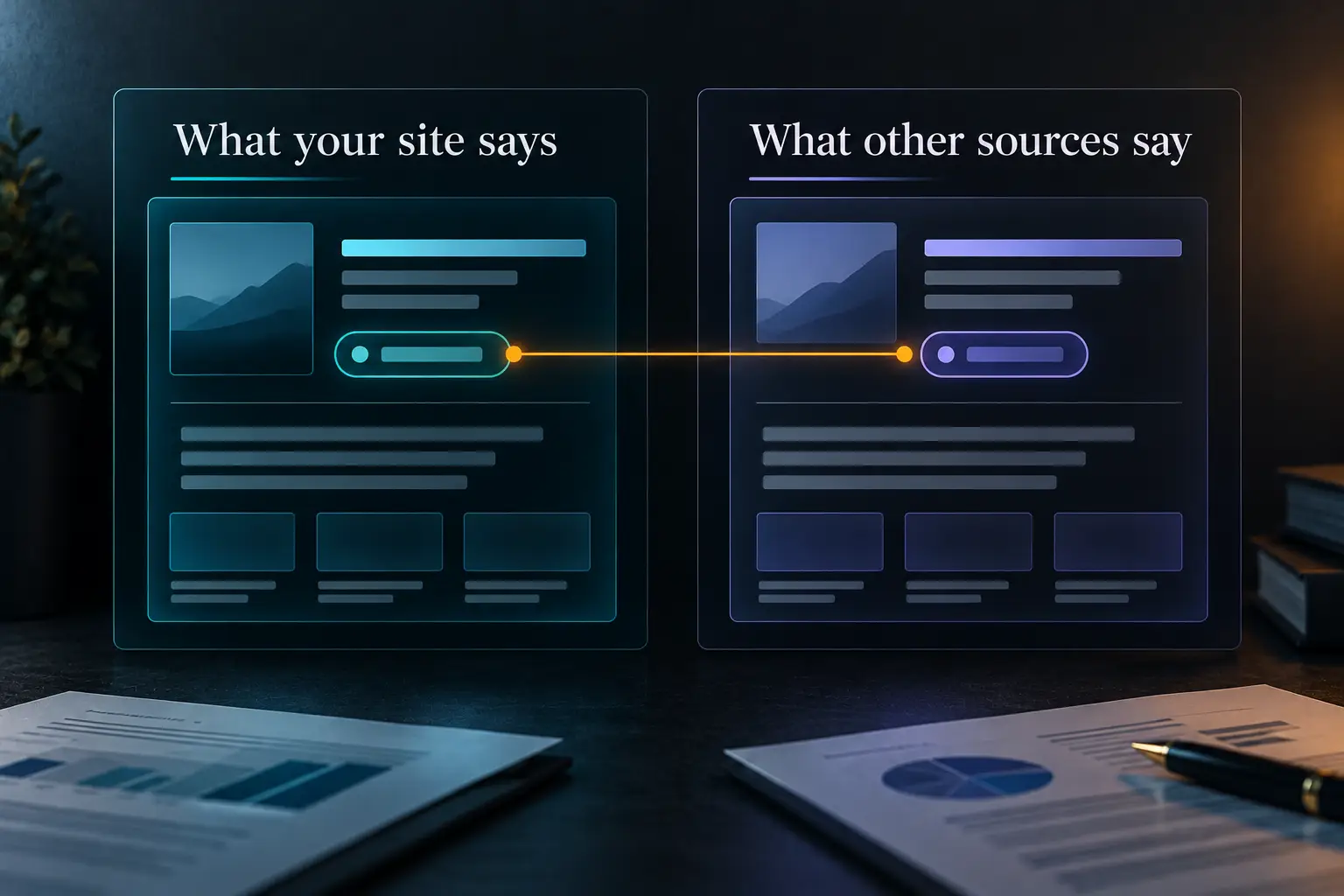
Categories are descriptions, and descriptions come from sources. A company’s own website describes it in the company’s preferred terms. Reviews describe it in the words customers use. Directories file it under whatever headings they maintain. Articles and analyst coverage describe it in their own vocabulary. These descriptions can agree, and they can drift apart. A product that calls itself a workflow platform on its own site could be described by reviewers as a project management tool, and by a directory as something else again. That example is hypothetical, but the pattern is ordinary.
Why would that matter for a list of options? When a buyer asks ChatGPT, Claude, Gemini, or Perplexity for options in a category, the assistant builds an answer from what it has available, and some of that may be shaped by how sources describe brands. If the sources an engine draws on tend to place a brand in a different category from the one the buyer used, the brand may be less likely to appear in answers to the buyer’s question. That is a possibility to check, not an established mechanism. Much of how any engine arrives at its answer can’t be observed from outside the model provider.
It also means that a good result on a named check can sit alongside an absence on a category question. An engine can describe your company accurately when asked by name and still not include it in a list for the category the buyer asked about. Describing a named company and assembling a list of options are different tasks, and the second one depends on how the brand is placed relative to the others.
Checking category fit is practical. Ask each engine an open question about the brand, such as what kind of company it is and what category of product it offers. Keep the full text of each answer. Then compare the wording the engines use with the wording a buyer would use for the same need. Next, look at how independent sources describe the brand: reviews, directories, articles, and analyst coverage. Note where the descriptions agree and where they diverge. The result is a set of observations about language, not a diagnosis.
How a brand is described is part of what we call the narrative layer in our framework, and it sits alongside the evidence available to support that description. A mismatch between the buyer’s wording and the wording used by independent sources is a lead worth following. It doesn’t prove that the mismatch is why the brand was missing from a list.
If the brand’s own description turns out to differ from the way independent sources describe it, there are choices. One is to leave things as they are, since sometimes the difference is small or reflects how customers actually talk. Another is to adjust the brand’s own language and, where the brand controls them, the descriptions it supplies to directories and profiles. Any change is an intervention, so it helps to state in advance what observation would show it had an effect. Then repeat the same panel of buyer questions afterward. Changing the questions at the same time would make the two sets of results incomparable. And even a before-and-after change on its own doesn’t establish that the change caused it, because other things move at the same time.
There is a practical benefit to doing this before any conclusion is drawn. Writing out how independent sources describe the brand, in their own words, can show whether the brand’s language matches how customers talk about the problem. A brand that describes its product in internal terms may find that reviewers describe the same product using the words a buyer would type. That gap is worth knowing about whatever an AI engine does with it, because buyers read those same sources directly. It also gives the team a shared reference. Marketing, product, and sales may each describe the company differently, and a side-by-side list of the wording each engine and source uses makes those differences visible without anyone having to argue about which is right.
Two cautions apply. Category descriptions can differ between engines, so a result on one engine doesn’t describe the others. And the check has to stay separate from collection problems: failed or missing responses should be counted on their own line, apart from valid answers that did not mention the brand.
The question to take from this is a simple one. Not only whether an engine can describe your company, but whether it would place you in the category a buyer is asking about. The second question is the one that decides whether a buyer who doesn’t know your name ever sees it.
FAQ
What does category fit mean in AI recommendations?
It refers to whether an AI assistant treats a brand as belonging to the category a buyer asked about. A brand has to be placed in that category before it can appear in a list of options for it. How engines make that placement isn’t fully observable from outside.
Can an AI engine describe my company accurately and still not list it for a category question?
It can happen. Describing a named company and building a list of options are different tasks. An absence on a category question is an observation to investigate, not proof of a specific cause.
How do I check how ChatGPT, Claude, Gemini, and Perplexity categorize my brand?
Ask each one an open question about what kind of company the brand is and what category it offers. Keep the full text of each answer, then compare the wording with the way a buyer would describe the same need.
Where do the descriptions of my brand come from?
Engines may draw on many places, including a brand’s own site, reviews, directories, articles, and analyst coverage. Which sources shape a given answer isn’t directly observable from outside the model provider.
If independent sources describe my brand differently from my site, should I change my wording?
That’s a judgment call, and a change is an intervention. State in advance what observation would show it had an effect, then repeat the same panel of questions afterward. A before-and-after change alone doesn’t show the change caused it.
Is this article reporting a result from Axis Suite?
No. It describes a way to examine category fit and doesn’t report a result for any specific brand.
About Axis Suite
Axis Suite is the independent intelligence layer that tracks what AI says about your brand and the observable evidence behind it, retrieval, narrative, recommendation, and corroboration signals, across engines including ChatGPT, Claude, Gemini, and Perplexity. Built by TrendAxis, Axis Suite works from a framework that separates Mentioned, Cited, Recommended, and Chosen. Axis Suite is measurement infrastructure, not a marketing quick fix. Explore the Proof Center.