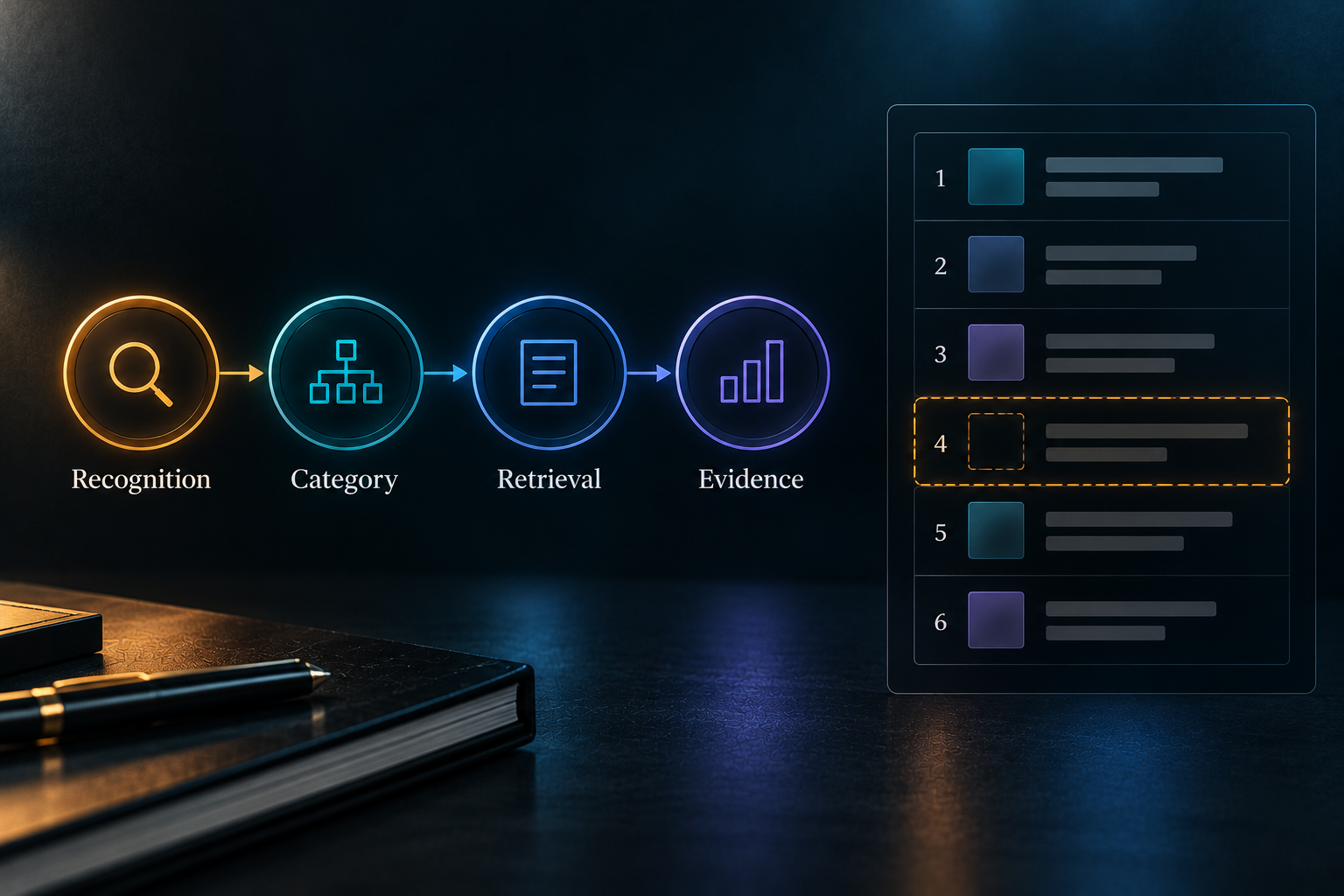
A hypothetical marketing leader runs the question a buyer would ask across ChatGPT, Claude, Gemini, and Perplexity. The answers list several vendors in her category, and her company isn’t among them. The instinct is to start changing things. A more useful first move is to decide where to look, because each possible explanation calls for a different kind of evidence, and none of them is established by the absence itself.
Start with what the engines can say about the brand. Ask each engine about the company by name and keep the full answers. The purpose isn’t to prove anything about the shortlist. It is to see whether each engine can produce accurate, reasonably complete information about the brand at all. An engine that searches the web may be retrieving that information live, so a good answer doesn’t show what the model itself learned. An engine that describes the company wrongly, confuses it with another, or says very little gives you a specific observation to follow. An engine that describes it well tells you that a lack of information about the name is less likely to be the whole story, which narrows the search without ending it.
Next, look at how the engines categorize the brand. A brand has to be treated as part of the category the buyer asked about before it can appear in a list for that category. Ask each engine what kind of company this is and what category it offers, then compare the wording with the buyer’s wording. A mismatch is a lead. It isn’t proof that the mismatch is why the brand was missing, and different engines may categorize the same brand differently.
Third, consider whether the engines can find and reach the brand’s information. For engines that search the web, this includes whether the brand’s own pages, and the sources that describe it, are accessible and appear when the engine looks. How each engine retrieves information is largely not visible from outside the model provider, so this area produces questions more than answers. It is still worth asking whether the brand’s key pages are publicly reachable and whether the sources describing it are reachable too.
Fourth, look at what supports the brand. Independent sources that describe the brand for this specific use case, such as reviews, directories, analyst coverage, and press, are part of the evidence an engine may draw on. Support that is thin, outdated, or inconsistent with the brand’s own description is a possibility to check. The question isn’t only whether sources exist, but whether they describe the brand in a way that connects to the buyer’s need.
These four areas echo the retrieval, narrative, and evidence signals in Axis Suite’s framework, but none of this is an automated diagnosis. They are questions for a person to investigate, in an order that starts with the cheapest checks and moves toward the ones that take more effort.
Throughout, the measurement discipline stays brief. Before trusting the result, check whether enough of the planned responses succeeded to support what is being reported. Missing answers must remain separate from answers that did not mention the brand, so a collection problem is never read as a result. A few missing responses don’t automatically undermine a measurement. Then repeat the same panel to assess stability. If the questions are broadened or reworded, that is a separate diagnostic test, and its result isn’t directly comparable with the first one.
It also helps to decide in advance how the findings will be reported. “AI doesn’t know our brand” is a stronger statement than most of these checks can support. A more accurate version names what was checked: which engines were asked, what each said about the company, how each described the category, and what the panel of buyer questions returned. The longer version is less dramatic and more useful, because it shows what was observed and what wasn’t, and it gives the next person a place to start. Timing is worth recording too. Engines and the sources they draw on change over time, so a note of the date on every observation makes it possible to tell later whether a difference came from the brand or from the moment the check was run.
When the findings come back, read them together. An engine that describes the brand accurately, a category mismatch, and thin independent support points to a different set of hypotheses than an engine that can say little about the brand at all. Even then, they are hypotheses. If the team chooses to act on one, it helps to state beforehand what observation would show the change had an effect, then repeat the same panel afterward. A before-and-after change on its own still doesn’t establish that the change caused it.
Sometimes the evidence doesn’t justify an intervention yet. In our framework, WATCH is a legitimate result in that case. It means continuing to observe, setting a date to check again, and writing down what would change the decision. A team that can say that clearly is in a better position than one that acted quickly on an explanation it hadn’t tested.
FAQ
What should I check first if my brand is missing from the options ChatGPT, Claude, Gemini, or Perplexity gives a buyer?
Start with what each engine can say about the brand when asked by name. Then look at how it categorizes the brand, whether its information is reachable, and what independent sources support it. Each is a question to check, not a diagnosis.
Why start by asking the engines about my company by name?
It shows whether each engine can produce accurate information about the brand at all, though a correct answer may come from a live search and not from what the model learned. It doesn’t show whether the brand surfaces on a list, but it narrows where to look next.
Does a mismatch between the buyer’s wording and the engines’ wording explain why my brand is missing?
It is a lead, not proof. Engines may categorize the same brand differently, and an absence can have several possible explanations.
How should I treat failed or missing responses in my results?
Keep them separate from valid answers that didn’t mention your brand. A few missing responses don’t automatically undermine a result, so check whether enough of the planned responses succeeded to support what you are reporting.
How do I know whether a result is stable?
Repeat the same panel of questions and compare the results. Broader questions or changed wording are a separate diagnostic test, not a directly comparable repeat. A before-and-after change on its own doesn’t establish what caused it.
When is waiting the right decision?
When the evidence doesn’t justify an intervention yet. In Axis Suite’s framework, WATCH is a legitimate result: keep observing, set a date to check again, and write down what would change the decision.
About Axis Suite
Axis Suite is the independent intelligence layer that tracks what AI says about your brand and the observable evidence behind it, retrieval, narrative, recommendation, and corroboration signals, across engines including ChatGPT, Claude, Gemini, and Perplexity. Built by TrendAxis, Axis Suite works from a framework that separates Mentioned, Cited, Recommended, and Chosen. Axis Suite is measurement infrastructure, not a marketing quick fix. Explore the Proof Center.