On November 12, the Interactive Advertising Bureau, the advertising industry’s trade body, released its AI-Era Attribution Blueprint. The announcement describes a framework that gives the industry a shared way to classify AI’s role in a conversion and to evaluate which parties can claim credit. It was developed by a working group of brand, agency, publisher, AI platform and measurement leaders. For a marketing team, the framework is more useful as a set of questions than as a verdict, and this article treats it that way.
A note on scope first. The announcement names three pathways for classifying a conversion but does not define them, and this article did not review the full Blueprint. It therefore does not explain the pathways or say which one a deal belongs in. It uses only the three questions the announcement states, and the exercise below is our own framing, not IAB’s method.
The announcement also draws a distinction that is easy to carry into a meeting: “A claim is not credit; it is the right to be evaluated for credit.” For a team with its own deals, that means a buyer’s recollection or a CRM entry gives someone a claim worth evaluating. It does not settle who earned the sale.
The announcement says the framework asks who or what created the intent, made the decision and completed the purchase. Take them in turn, with one closed deal in front of you.
Who or what created the intent? The CRM’s first-touch field may seem to answer this, but it records the first touch the system captured, which is not necessarily where the buyer’s interest began. A win interview may say more, in the buyer’s own words. Some deals will have a clear answer. Others will have only a first touch.
Who or what made the decision? For a B2B deal, the proposal and contract usually show the named people involved, and sales notes may show who weighed in. What they usually do not show is what informed those people. That sits in the buyer’s account, if anywhere.
Who or what completed the purchase? The signed order or contract usually shows this, and it is often the least ambiguous of the three. It is still worth writing down, because the question is part of the framework and because its answer anchors the other two.
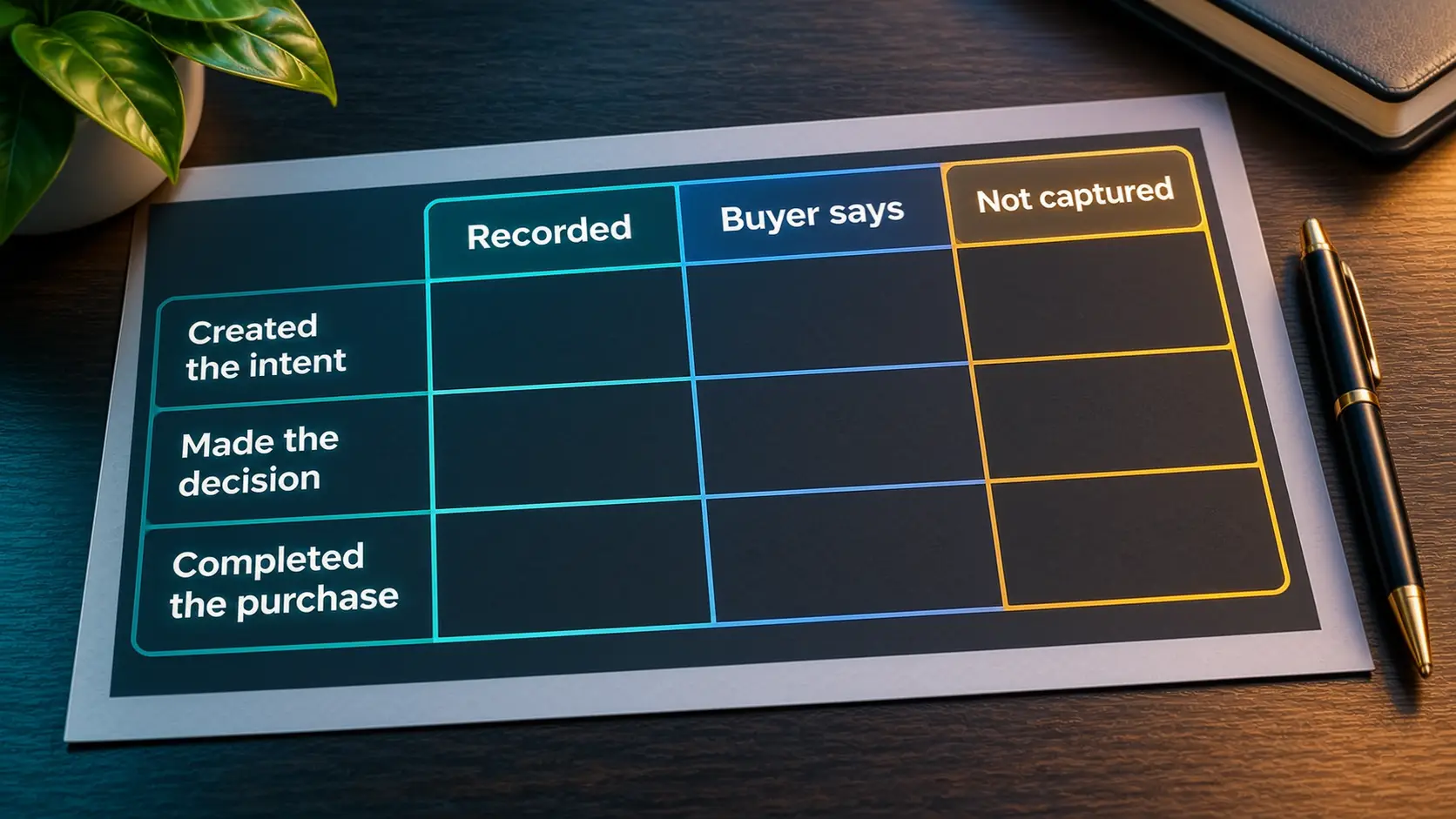
Now put the answers on one page. Draw a grid with the three questions down the side and three columns across the top: recorded in our systems, said by the buyer, and not captured. For each question, mark which column your evidence belongs in. Be literal. If the only evidence is a first-touch field, mark it as recorded and note what it can and cannot show. If the only evidence is what a buyer said, mark it as the buyer’s account.
The third column deserves attention. The announcement says that much of the evidence needed to support these claims is either not captured or sits inside AI platforms. For a small team, that likely means some cells stay empty however carefully it looks. The column is not the same as the “what remains unknown” field in a win-interview record. It covers only the three questions for one deal, while “what remains unknown” also holds questions no record could answer, such as whether the sale would have happened without AI. An empty cell is a finding, not a failure. It says what the team would need to start capturing, and it prevents a confident sentence in a budget meeting from resting on nothing.
Choosing the deal matters. Start with a closed deal where someone on the team remembers the buying process well and a win interview took place, because a deal with no buyer account leaves the middle column empty by construction. Repeat the exercise on a second deal of a different type before drawing any conclusion, and note which deals were chosen and why. A grid filled in for one deal describes that deal. It also helps to date the grid, since both the records and the buyer’s recollection change, and a dated grid can be compared with a later one.
Blanks become small tasks. If no record captures how the shortlist formed, the task is a free-text field for the buyer’s own words, filled in during the win interview. If the decision-makers are not recorded, the task is a note on the opportunity. None of these tasks needs new software or a view on AI. They make the next grid less empty, and they make the team’s later sentences easier to support.
Teams can use the grid to line up different views of one deal. Ask marketing, sales and finance to fill it in separately, then compare. Where they differ, the difference is the discussion. One person’s “recorded” may be another’s “buyer says,” and noticing that early is cheaper than discovering it during a reallocation.
None of this allocates credit. The announcement says the framework works alongside existing attribution systems and defines claims and evidence, and it does not say how much any channel earned. Nothing in a filled grid shows that ChatGPT, Claude, Gemini or Perplexity influenced a sale, or how often they do. It shows what your records can and cannot say about a deal that has already closed.
FAQ
What does IAB’s AI-Era Attribution Blueprint ask? According to IAB’s announcement, the framework asks who or what created the intent, made the decision and completed the purchase. It uses the answers to classify a conversion and to decide which claims are eligible for evaluation.
Does this article explain IAB’s three pathways? No. The announcement names the pathways without defining them, and this article did not review the full Blueprint. It uses only the three questions.
What is the difference between a claim and credit? IAB’s announcement says a claim is the right to be evaluated for credit, not credit itself. A buyer’s account or a CRM entry can support a claim, and credit needs more evidence.
What does a blank cell in the grid mean? It means the evidence is not captured in your systems or the buyer’s account. That is a finding that shows what to start recording, not a failure.
Does the grid show whether AI influenced a sale? No. It shows what your records can and cannot say about one closed deal. It does not show causation or how often AI plays a role.
Is this article reporting a result from Axis Suite? No. It describes a way to read deal records and reports no result for any brand.
About Axis Suite Axis Suite is the independent intelligence layer that tracks what AI says about your brand and the observable evidence behind it, retrieval, narrative, recommendation, and corroboration signals, across engines including ChatGPT, Claude, Gemini, and Perplexity. Built by TrendAxis, Axis Suite works from a framework that separates Mentioned, Cited, Recommended, and Chosen. Axis Suite is measurement infrastructure, not a marketing quick fix. Explore the Proof Center.