You open ChatGPT or another AI tool, type in a prompt about your industry, and hold your breath. The answer generates, and there it is. The AI mentioned your brand. You take a screenshot, share it with your team, and celebrate a marketing win.
But did you read what the AI actually said about you?
Most businesses check whether AI mentions their brand. Very few check whether AI describes them correctly. We treat AI like a traditional search engine, focusing entirely on getting seen. We assume that if we show up in the results, we are winning the game.
This assumption is dangerous. We are tracking the wrong metric. We measure visibility, mentions, and citations, but we ignore the narrative. When it comes to AI discovery, visibility gets you in the room, but accuracy drives the final selection.
This guide breaks down why narrative accuracy is the new frontier of brand perception, how small gaps compound over time, and what you must do to fix your AI strategy before your competitors take your place.
Visibility vs. Accuracy: The AI Tracking Trap
Visibility and accuracy answer two entirely different questions.
Visibility asks: Does the AI know we exist?
Accuracy asks: Does the AI understand exactly what we do and who we serve?
In traditional search engines, visibility was the primary goal. You wanted a link to your website at the top of the page. The search engine did not formulate an opinion about your business; it just pointed the user to your domain. You controlled the message once the user clicked the link and arrived at your website.
AI search changes the rules completely.
Generative AI models do not just point users to your website. They synthesize information, summarize your value proposition, and actively compare you to your competitors. They act as automated consultants, giving users a final recommendation.
If the AI tells a user that your premium consulting firm is a “budget-friendly entry-level agency,” you have achieved visibility. The user knows your name. But you have lost the sale. The AI delivered an inaccurate narrative, and the user will act on that bad information.
High visibility paired with low accuracy actually hurts your business. It introduces your brand to potential buyers while simultaneously disqualifying you from their consideration.
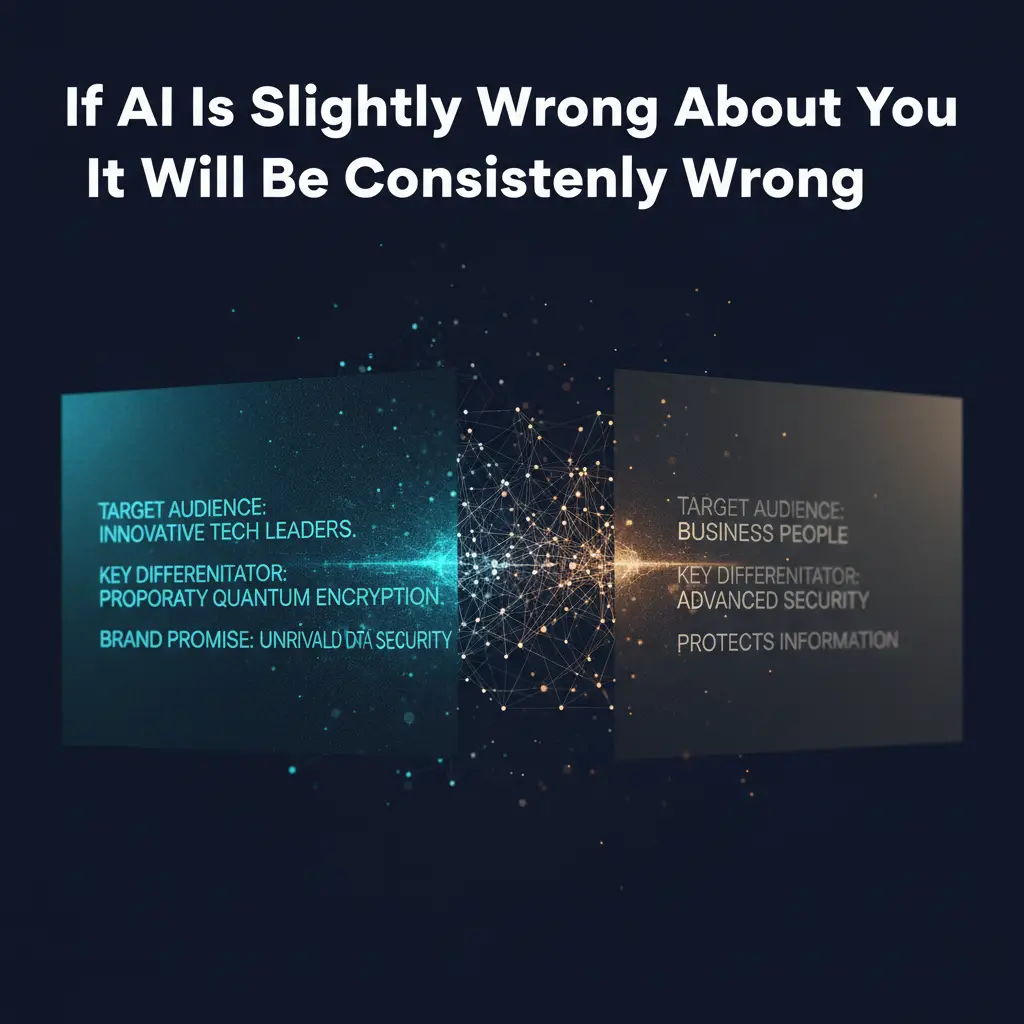
If AI Is Slightly Wrong, It Is Consistently Wrong
Human beings are capable of nuance and correction. If a human colleague misunderstands your product, you can have a quick conversation to clear things up. They will update their mental model and describe you correctly the next time.
AI models operate differently. They rely on the data signals they scrape from across the internet. If the signals surrounding your brand are mixed, outdated, or slightly off-center, the AI forms a flawed baseline understanding of your company.
Because AI generates responses based on probability and patterns, a slight misunderstanding does not stay small. It hardens into a rigid narrative.
If an AI is slightly wrong about you, it will be consistently wrong about you.
It will repeat this inaccurate positioning across every prompt. It will share this flawed narrative during every user session. It will distribute the same generic description across every platform that uses its underlying model.
Imagine your software platform recently pivoted from serving small businesses to exclusively serving enterprise clients. You updated your homepage, but your old reviews, legacy directory listings, and past press releases still mention “small business.”
The AI reads this conflicting data and attempts to find a middle ground. It labels you as a “mid-market tool.”
You are no longer an enterprise solution. You are no longer a small business solution. You are stuck in the middle, and the AI will confidently repeat this error to every single enterprise buyer who asks for a recommendation.
The Compound Effect of Narrative Drift
This loss of narrative accuracy rarely happens dramatically. You do not wake up one morning to find your brand entirely misrepresented.
Instead, it happens quietly through a process called narrative drift.
A description that was once sharp and specific becomes slightly blurred. A confident recommendation becomes slightly hesitant. A competitor gets framed just a little more favorably in the same paragraph.
These small gaps compound over time.
Every time the AI pulls from an outdated directory or reads an uncorrected mention on a third-party blog, the drift accelerates. Your solid brand identity fragments into a generic, weak profile.
While your narrative drifts, your competitors might be tightening theirs. If a competitor actively feeds clear, consistent, and accurate data into the ecosystem, the AI will build a highly confident profile of their brand.
When a user asks the AI for a recommendation, the system will compare your fragmented profile with your competitor’s precise profile. AI favors certainty. It will recommend the competitor.
You will lose the lead, and you will never even see it happen. You did not disappear from the dataset. The AI simply understood your competitor more precisely.
Taking Control of Your AI Signal
You cannot bribe an AI to recommend you, and you cannot manipulate it with traditional keyword stuffing. To improve your brand perception in the age of AI, you must take control of the signals you feed the machine.
A successful AI strategy requires absolute consistency across the internet. Here is how you start pulling your narrative back into focus:
1. Centralize Your Positioning
You need a clear, unshakeable core narrative. Define exactly what you do, who you do it for, and why you are the best choice. Write this in clear, direct language. Avoid marketing fluff and corporate jargon. AI models parse natural language best.
2. Clean Up Your Digital Footprint
AI reads everything. It reads your website, your press releases, your social media profiles, and third-party review sites. If your website says one thing and your LinkedIn page says another, you are creating narrative drift. Audit every platform you control and ensure the messaging perfectly matches your central positioning.
3. Address the Uncontrolled Signals
You cannot edit a blog post written by a third party, but you can influence the broader conversation. Encourage satisfied customers to leave detailed reviews that mention your specific capabilities. Publish authoritative, deeply researched content that reinforces your expertise. The more high-quality, accurate data you put into the ecosystem, the less weight the AI will give to outdated or inaccurate mentions.
4. Monitor the Machine
Stop searching for your brand name just to see if you show up. Start asking AI models complex, specific questions about your industry. See where they place you. Ask them to compare you to your top three competitors. Analyze the language they use to describe your features. Identify exactly where the narrative is breaking down, and trace that misunderstanding back to the source.
Protect Your Brand Narrative Today
We are moving into an era where AI acts as the primary gatekeeper between your business and your buyers. You cannot afford to let an algorithm guess what you do.
Narrative accuracy is not a passive metric you check once a year. It is an active, ongoing strategy. Small inaccuracies will cost you revenue, trust, and market share.
Take control of your story before the machine writes a different one.
Audit your AI presence this week. Open the top AI platforms, act like your ideal customer, and ask for a recommendation. Look closely at how these systems describe you. Find the gaps. Fix the signals. Ensure that when AI speaks about your business, it speaks the exact truth.