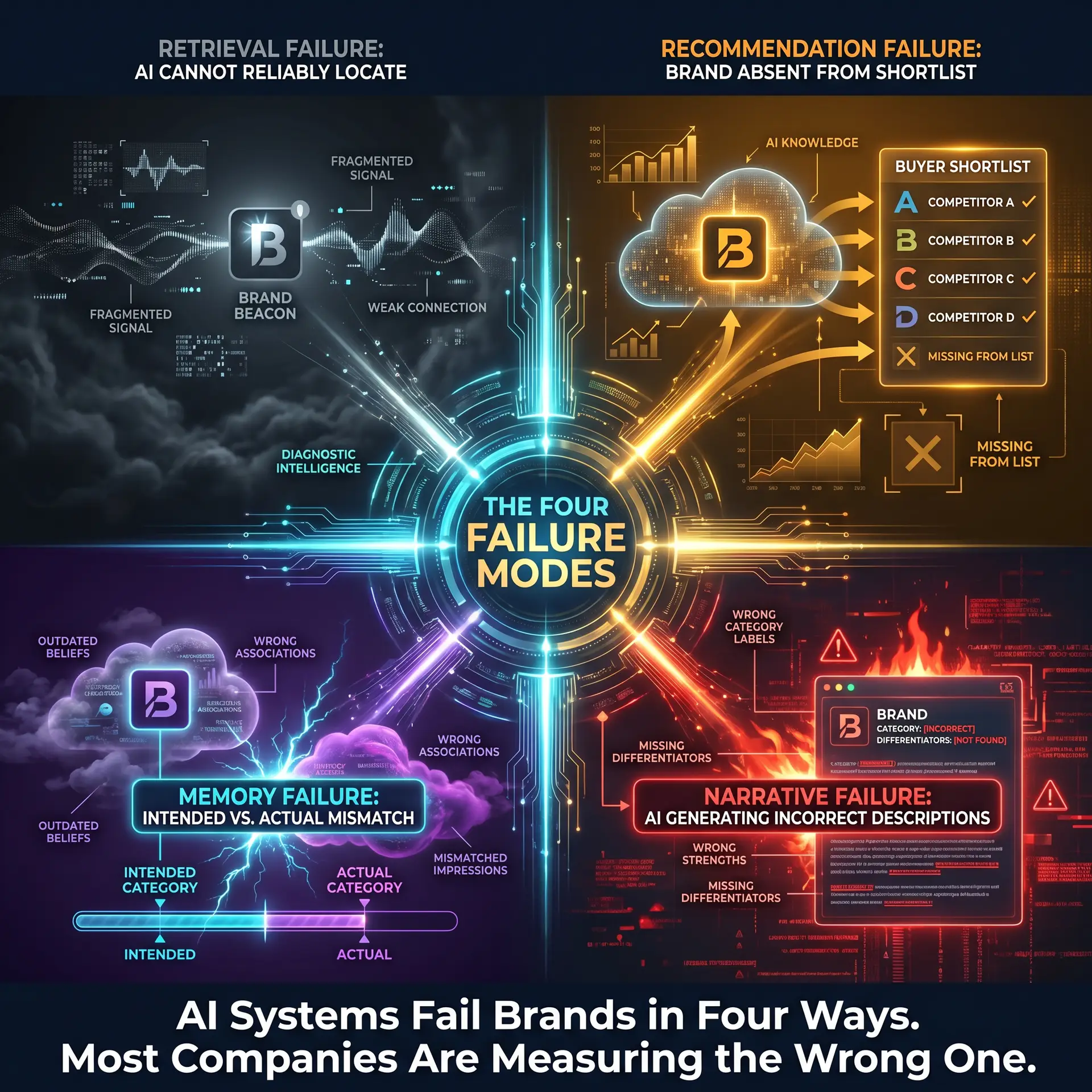
Most businesses treat AI visibility as a single measurement.
Are we appearing in AI answers?
That question assumes all AI visibility problems are the same.
They are not.
After months of scanning brands across AI systems four distinct failure modes keep emerging. Each one looks like a visibility problem from the outside. Each one requires a completely different response.
Understanding which failure mode you are actually experiencing changes everything about where you focus your effort.
Why the Wrong Diagnosis Wastes Resources
This is the practical problem most businesses are currently facing.
The measurement most commonly used to assess AI visibility detects retrieval failure. Whether AI can find and describe your brand.
But the most common failure mode affecting B2B brands right now is recommendation failure. AI knows the brand, can describe it, and can retrieve it. But when buyers ask who to choose, the brand does not make the shortlist.
Applying a retrieval fix to a recommendation problem produces no results.
Applying a recommendation fix to a memory problem leaves the real issue untouched.
The right diagnosis is not just useful. It is the entire strategy.
The Four Failure Modes
Retrieval Failure
AI cannot reliably find you.
The signals AI uses to locate and identify your brand are weak, inconsistent, or absent. Schema markup. Entity clarity. External presence. Structured information. A brand with retrieval failure may appear occasionally but cannot be reliably surfaced when AI needs to reference it.
The fix for retrieval failure is entity clarity work. Stronger schema markup. More consistent external presence. Structured information that reduces AI ambiguity about what your brand is and what it does.
Recommendation Failure
AI finds you but recommends competitors instead.
AI knows the brand. Can describe it. Has enough signal to retrieve it. But when buyers ask who to choose, the brand does not make the shortlist. This is the Discovery Gap and it is the most common failure mode affecting B2B brands right now.
The fix for recommendation failure requires category association building. Co-citation strategy. Comparison context presence. Buyer-intent signal strengthening across the sources AI trusts.
Memory Failure
AI has formed incomplete, outdated, or drifting impressions about your brand that persist and compound over time.
This is the failure mode most businesses have never considered measuring.
Most AI visibility tools tell you whether you were mentioned today. Memory failure is about something deeper. The durable impressions AI has formed across many interactions. What category it consistently files you under. Whether it describes you with words of authority like established and leading or words of hesitation like emerging and limited information. Which competitors it mentally associates you with. What it has never learned about you because the supporting evidence is not out there.
These impressions do not reset between conversations. They compound.
We saw this recently in our own testing. A brand set its intended category as one thing. AI was consistently filing it under a partial match. A narrower and less strategic category than the brand actually occupied. Every comparison AI made, every competitor it placed alongside the brand, every recommendation scenario it entered was filtered through that wrong category lens. The brand was not invisible. It was consistently misrepresented.
That is memory failure in its most common and most damaging form.
Memory failure reveals itself through longitudinal scanning over time. A single scan gives you a snapshot. Repeated measurement across weeks and months reveals the durable pattern that is actually driving how AI represents you.
The fix for memory failure requires Memory Intelligence work. Understanding what AI has durably come to believe about your brand. Identifying where the category placement is wrong. Diagnosing where hesitation language has replaced trust language. Finding the evidence gaps that are preventing AI from forming the right impressions.
Narrative Failure
AI describes you incorrectly in the moment.
The brand appears and gets recommended. But the description AI gives is wrong or misleading. Wrong category emphasis. Missing key differentiators. Competitor framing embedded in the response.
Narrative failure is the most dangerous failure mode because a buyer reading an inaccurate AI description forms an incorrect first impression before ever visiting the website.
The important distinction: Memory failure is observational and longitudinal. It reveals what AI has durably come to believe. Narrative failure is immediate and correctable. It is what AI says about you right now that can be actively defended and improved.
The fix for narrative failure requires AI Narrative Defense. Active monitoring and correction of how AI describes and frames your brand across platforms.
The Four Layer Intelligence Stack
These four failure modes map directly to four layers of AI intelligence.
Retrieval Intelligence tells you what AI can find.
Recommendation Intelligence tells you what AI selects.
Memory Intelligence tells you what AI keeps believing.
Narrative Defense tells you what to correct.
Most businesses are only measuring the first layer.
The ones building durable AI visibility are diagnosing across all four.
The Four Failure Mode Self-Audit
Run these four tests to identify which failure mode your brand is experiencing. The complete audit takes fifteen minutes.
Test 1: Retrieval (3 minutes)
Ask AI across ChatGPT, Perplexity, and Claude: “What is [your brand] and what do they do?”
If AI cannot describe you accurately on any platform you have retrieval failure.
Test 2: Recommendation (3 minutes)
Ask AI: “Who would you recommend for [your category]?” without mentioning your brand.
If you do not appear you have recommendation failure.
Test 3: Memory (4 minutes)
Ask AI three questions across ChatGPT, Perplexity, and Claude:
“What category does [your brand] belong in?”
“What is [your brand] known for?”
“Who does [your brand] typically compete with?”
Evaluate: Is the category accurate? Is the language confident or hesitant? Are the competitor associations correct? What is missing?
If AI is filing you under the wrong category, using hesitation language, or missing key associations you have memory failure.
Note: Memory failure reveals itself fully across repeated scans over time. A single test gives you a snapshot. The durable pattern emerges across multiple measurements.
Test 4: Narrative (4 minutes)
Ask AI: “How would you describe [your brand] compared to [main competitor]?”
Compare the AI description to how you actually describe yourself.
If the description is inaccurate, incomplete, or uses competitor framing you have narrative failure.
Most brands will find at least two failure modes. The one that matters most for pipeline is usually recommendation failure. The one that matters most for brand integrity is usually memory or narrative failure.
The Diagnostic Is the Strategy
Knowing which failure mode you have changes everything about where you invest your effort.
Retrieval failure needs entity clarity work.
Recommendation failure needs category association and co-citation strategy.
Memory failure needs longitudinal intelligence to understand durable AI impressions.
Narrative failure needs active monitoring and correction.
None of these interventions are interchangeable.
The businesses that diagnose correctly before acting will move significantly faster than the ones applying generic AI visibility fixes to specific failure modes.
FAQ
What is the most common AI failure mode for B2B brands?
Based on what we observe in scans, recommendation failure is the most common. AI knows the brand and can describe it accurately but does not include it when buyers ask who to choose. This failure mode is particularly insidious because traditional visibility metrics look healthy while the brand is systematically absent from the buyer decision stage.
How is memory failure different from narrative failure?
Memory failure is observational and longitudinal. It reveals the durable impressions AI has formed about your brand over time including wrong category placement, hesitation language, and incorrect competitor associations. Narrative failure is immediate and correctable. It is what AI says about your brand right now that can be actively defended and improved. Both matter but they require different interventions.
How do I know if I have memory failure?
Ask AI what category your brand belongs in, what it is known for, and who it competes with across ChatGPT, Perplexity, and Claude. Compare those answers to how you actually describe your brand. If AI is filing you under a partial match or outdated category, using hesitation language like emerging or limited information, or associating you with competitors that no longer reflect your market position, you have memory failure.
Why does category placement matter for AI recommendations?
AI uses category placement to determine which competitive context to place your brand in. A brand filed under the wrong category gets compared against the wrong competitors in every future recommendation scenario. It enters shortlists for the wrong buyer use cases. The mismatch affects every downstream AI interaction until the underlying impression is corrected.
How long does it take to address each failure mode?
Retrieval failure improvements are typically the fastest, often showing measurable results within two to four weeks of consistent entity clarity work. Recommendation failure takes longer because it requires building category association signals across multiple trusted sources. Memory failure is the most longitudinal because changing durable AI impressions requires consistent corrective signals over weeks and months. Narrative failure can show improvement quickly once specific corrections are identified and implemented.
What is the difference between AI visibility and AI failure mode diagnosis?
AI visibility measurement typically answers whether you appeared in AI responses. AI failure mode diagnosis answers why you are failing at the specific layer that matters most for your pipeline. You can have strong visibility metrics and still be experiencing significant recommendation or memory failure. The diagnosis reveals which problem you actually have so you can apply the right intervention.
Start diagnosing your failure mode here: Axis Suite